Affichage des articles dont le libellé est .Introduction to..... Afficher tous les articles

Gòtic Tour


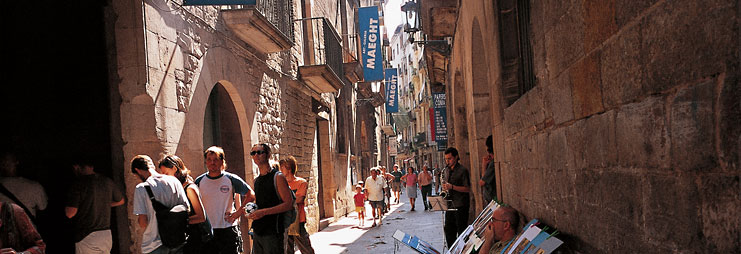
A stroll through Barcelona’s Gothic Quarter brings to light the early Roman city of Barcino and the medieval town with its palazzos, mansions and Gothic churches. This is the style that defines “the heart of Barcelona”: a neighbourhood where the splendour of the historic past coexists with the vibrancy of the present. (map)

Behind the cathedral, at the centre of the Roman city, today’s Gothic Quarter, marked by the point where the two main roads, Cardus ( today Carrer del Bisbe ) and Decumanus ( Carrer Llibreteria ), converged, we can still see the remains of the Roman Temple of Augustus (1). In fact, the original centre of Roman and medieval Barcelona still forms the core of 21st-century Barcelona. Its maze of narrow streets and squares is steeped in the city’s past and present.

Going around the back of the cathedral we will stop next at the 14th century Cloister (2), famous for its geese.Turning left we can visit Sant Sever Church (3), the only one in the city’s few Baroque-era churches to remain completely intact. On our left we discover the peaceful Plaça Sant Felip Neri (4), a tiny square with a charming little fountain. Going back toward the center we will pass by The Palau Episcopal (5)
 which adjoins the cathedral on the west. The two round towers on the Portal del Bisbe date from Roman times and the inner courtyard, with its Romanesque arcades from the 14th century. On the other side, stands the entrance to the Casa de l’Ardiaca (6), or Archdeacon’s House, which contains interesting archaeological remains of the ancient Roman wall of Barcelona.The passage between these 2 buildings marks one the gates in the ancient wall and opens on Plaça Nova (7)  which was the site of the city’s hay market in the middle age.

Next on the right, on the Pla de la Seu, the Cathedral de la Santa Creu i Santa Eulàlia (8) reflects the different generations who have left their imprint and the blend of architectural styles in this predominantly Gothic building which needs to be viewed inside in order to fully understand its splendour. Adjacent to the Cathedral stands the Casa de la Pía Almoina  (9), with two sections, the Gothic one was built around 1435, and the Renaissance one added in 1546, currently holds the Diocesan Museum.The narrow street on the east side of the Cathedral leads to the Verger del Palau Reial (10), the garden of the former Royal Palace of the Counts of Barcelona. One building of this Palace now hosts the Museu Frederic Marès (11) which includes an extensive and valuable collection of art works and everyday objects from the 15th to 19th centuries. On the same street, the next building is the 16th-century Palau del Lloctinent (12), or Lieutenant’s Palace, which has a beautiful Renaissance courtyard and is currently home to the Archive of the Crown of Aragon. On the other side, this Palace, the Palau Reial and the 14th-century royal chapel of Santa Àgata form the Conjunct Monumental de la Plaça del Rei (13) which is, arguably, the Gothic architectural ensemble that best exemplifies the city’s medieval past. The royal palace, the Palau Reial Major, and its surrounding buildings, enclose a harmonious and peaceful square which is still imbued with Barcelona’s splendour during the Middle Ages. Below the square, you can visit the impressive archaeological remains of Roman Barcino.

Leaving la Plaça del Rei, we cross la Plaça Ramon Berenguer El Gran and head southeast toward la Plaça de l'Angel. To the right, just off the wide main street leading to the southeast, can be seen remains of the old town wall, on which stands the Palau de Requesens. We now turn right into la Carrer Llibreteria, one of the oldest street of Barcelona, turn left into la Carrer de la Dagueria and reach l'Eglesia Sants Just i Pastor (14), supposedly the oldest remaining church of the city. Following la Carrer d'Hercules, on the right side of the church, we reach now the City Hall (15)  and the seat of the Catalan Government, the Palau de la Generalitat, and the Plaça de Sant Jaume (16), right in the middle of this Barcelona neighbourhood, the end of this tour. Very near the Plaça de Sant Jaume, is the old Jewish Quarter, the Call Jueu, with its endless narrow streets, where some remains of the ancient synagogue still survive.

Montjuïc tour


Compared to the booming street life, the human warmth, hustle, and bustle of Barcelona, Montjuïc may feel remote, but the art and architecture concentrated around this lush promontory, covered with parks and gardens, more than justify spending a day of exploring the following 14 sites to visit on this walking tour.    MAP IT


But before we start let's have a special thought for our Celt, Jewish and Roman ancestors :
Several thousand years ago, Iberic Celts settled on the Montjuïc, a 173 meter high hill southeast of Barcelona's current city center. The hill was later used by the Romans as a ceremonial place.
This hill overlooking the south side of the port is said to have originally been named Mont Juif for the Jewish cemetery once on its slopes, though a 3rd-century Roman document referring to the construction of a road between Mons Taber (around the cathedral) and Mons Jovis (Mount of Jove) suggests that in fact the name may derive from the Roman deity Jove, or Jupiter.
Amen.

The most spectacular way to reach the Castle and other attractions at Montjuïc is via the cable car that crosses the port : the Transbordador Aeri. You've seen what it's like and, let's say, you would prefera less vertiginous experiment ? No problem, a funicular land-based service climbs the hillside from Paralell Metro station in Poble Sec, and makes a final stop immediatly below the castle at the top of Montjuïc. Or we could climb on bus 150 that connects all the sites of Montjuïc with the Plaça d'Espanya Metro station.

The eastern side of the hill is almost a sheer cliff, giving it a commanding view over the city's harbor and of the Mossèn Costa i Llobera Gardens immediately below. The collection presented by these gardens is considered one of the most important in the succulent plant world. But it is a little off the road and I suggest we start our day in Montjuïc at the top of the hill (a height of 173 meters) which was the site of several fortifications, the latest of which, the Castell de Montjuïc (1) remains today. The Mirador de l'Alcalde (2), the Mayor's Viewing Point, a garden located on the mountain of Montjuïc very near the castle at the top, honours its name by the exceptional views of Barcelona it provides. Going down, we will go through the Gardens of Joan Brossa (3)  and the lush Jardins de Mossèn Cinto Verdaguer (4).

Montjuïc is now Barcelona's art enclave, with nearly every painting in town hanging in the Miró Foundation (5) or the  Museu Nacional d'Art de Catalunya ( MNCA ). Opposite the main entrance to the MNCA the impeccably maintained gardens known as the Jardins Maragall (6), in which stands the Palau Albeniz, built in 1929 and with murals by Salvador Dali, was named after the Catalan poet Joan Maragall i Gorina (1860-1911).

More recently, the 1992 Olympic Games brought about major renewal. The Olympic Ring (7), the main site of the Olympic Games, features the stadium, the Estadi Lluís Companys, Arata Izosaki’s sports palace, the Palau Sant Jordi, and the telecommunications tower designed by Santiago Calatrava. Nearby, the Museu Olímpic i de l'Esport Joan Antoni Samaranch and the Botanical Gardens  are also unmissable sights as you explore the Parc de Montjuïc.
 
The Historic Botanic Garden (8) , a little treasure among the gardens of Barcelona, is nestled in the site of two old quarry pits in the Foixarda sector of Montjuïc, behind the MNAC. The  Museu Nacional d'Art de Catalunya (9)  contains what is considered the world's best collection of Romanesque murals and frescoes removed for restoration from Pyrenean chapels in the 1930's. In addition, the MNAC is the home of the Art Modern collection of impressionist and Moderniste painters, as well as an impressive Gothic collection.  Before or after the visit, depending on the time, we could have a nice lunch at the Oleum  a beautiful restaurant located inside the MNCA with a superb view over Barcelona.

Montjuïc Hill has borne witness to, and been the focus of key events that have shaped its personality. The first such event was the 1929 International Exhibition held in Barcelona which fostered the development of the zone ( the MNAC is housed in the colossal Palau Nacional, the centrepiece of the 1929 exhibition ). The Poble Espanyol (10), with its “artisans’ village”, was built to show visitors a representative sample of Spanish architecture. The Pavelló Mies van der Rohe (11), which was the German pavilion at the event, is a superb example of Bauhaus architecture.
Just across the street, the former Casaramona textile factory (12), a modernista landmark by Puig i Cadafalch, is now home to CaixaForum, a cultural centre which hosts temporary exhibitions. At the foot of the Palau Nacional the Magic Fountain (13) was built for the 1929 Universal Exhibition. When active, it constantly changes color and shape offering a spectacular display of music, water acrobatics and lights which generate over 50 kinds of shades and hues...

By now we should be exhausted, ready to go back to our hotel. No ? OK let's do some shopping ! But in an unusual place : Arenas (14)


Old City East Tour

Via Laietana was constructed at the turn of the twentieth century thus producing another divide in the Barri Gòtic : the area east of it is La Ribera. Part of La Ribera is referred to as El Born. Born is Catalan for jousting field. A little more south, Baceloneta was originally inhabited by fisherman and the neighborhood still retains the atmosphere of a seaside village.

During the Middle Ages La Ribera (the shore) was known as Barcelona’s wealthiest neighborhood. Handsome medieval mansions line the narrow streets; one of them is home to the popular Picasso Museum. Today the area closest to the sea remains affluent and lively. Fashionable bars, galleries, shops and restaurants can be found here, especially along the main thoroughfare, “Passeig del Born”, which has led to the area near the seafront being referred to simply as “El Born”.
Barceloneta is home to one of Barcelona's liveliest beaches as well as some of the best seafood restaurants to be found in the city. At night the seaside booms to the sound of the numerous, lively beach-side bars and cafes that are found here.
The route is materialized on the map by a purple line, leading to the points of interest mentioned below. It includes 7 major sites, each represented on the map by a dark rectangle, and which have in this blog their own page of description and pictures, accessible by clicking on their name. Each of these pages has a "back" link at the end to return to the tour page. All these pages can be selected by clicking the "Old City East Tour" label in the right column of the blog". The other links open in a new tab/window the maps, pictures,pages external to this blog.
 
Plaça de l'Angel. Known in medieval times as the Plaça del Blat ("Square of Wheat"), since all grain sales were made here, this small, atmospheric square stands at the busy junction of Jaume I and Laietana on the eastern edge of the Barri Gòtic.

From the Plaça de l'Angel take Carrer Boria right; then turn left into Carrer Mercaders and immediately right again to Plaça Santa Caterina. 

Plaça Santa Caterina. The oldest working market in the area, Mercat de Santa Caterina (1), occupies the original site of a medieval convent, and provides the usual rich cornucopia of Mediterranean produce. In 2005, after a protracted period of renovation, the market was reopened with a stunning new moderniste design,  whose colorful waved roof owes more than a little to Gaudí. It's open every day except Sunday.

From the south-facing side of the market take Carrer Sant Jacint, turn right into Carrer Corders, and then south into the Placeta d'en Marcus.

Placeta d'en Marcus. Well worth a peek is th diminutive 12th-century Capella d'en Marcus, nestling in this tiny Placeta, near the junction of calles Montcada and Carders (the latter means "Woolcomber's Street"). Originally conceived by one Bernat Marcus as a sanctuary for luckless travelers who reached the city after the gates had been closed, the chapel may have been headquarters of the country's very first postal service.

Continue south across Carrer Princesa to reach:

Carrer Montcada. Named after a powerful merchant, Guillem de Montcada, who in 1153 built a long-since-disappeared palace here, this charming medieval street would be interesting enough to stroll along even if it didn't contain some of the city's most interesting museums. The elegant buildings lining the street are reminders of the time it was a wealthy trading center; vast fortunes were made here by adroit and ambitious merchants.

Carrer Montcada, 15-21. Located in no fewer than five former palaces in Carrer Montcada, the Museu Picasso (2) is generally rated the most popular museum in town. In essence it covers the artist as a young man, and even the older works on display were created when the Malagueño was a mere 20-something. Exhibits range from notes and rough sketches to lithographs, ceramics, and oil canvases. Highlights are Las Meninas (his take on Velázquez's painting of the same name) and The Harlequin; although time will be short, keep an eye open for La Ciencia y la Caridad (Science and Charity), a masterpiece created while Picasso was at school.
Carrer Montcada, 12.  The Palau del Marquès de Lió has been the residence of several local noble families, among which the Marquès de Lió, which today gives its name to the building. It is one of the venues of the Disseny Hub Barcelona (design hub) and hosts the temporary exhibitions of the Museu Tèxtil i d'Indumentària,  The oldest preserved part is a tower and two coffered ceilings dating from the late thirteenth century.
Carrer Montcada, 14. Atmospherically housed in the 15th-century Palau Nadal, close to the above two museums, the Museu Barbier-Mueller d'Art Precolombí, a branch of the great Geneva museum, used to offer one of the best displays of pre-Columbian art and has been drawing in the crowds ever since it opened in 1997. Among its highlights was a dazzling selection of gold, jewelry, and masks. Unfortunately it closed on September 14, 2012

Continue down Carrer Montcada to the Passeig del Born. Turn right onto Carrer de Santa María.

Plaça de Santa María. Built in the 14th century during a period of just over 50 years (quick for the time), the grandiose, high-vaulted basilica Santa María del Mar (3), honoring the patron saint of sailors, used to stand on the city's shore when the sea reached further inland. As the welfare of sailors mainly depended on the clemency and protection of "Our Lady of the Sea," in those days large numbers of penniless people helped without pay on its construction. Bronze figures of two porters on the door commemorate this, and the west portal is flanked by statues of Peter and Paul.
Today it's one of Barcelona's most imposing Gothic structures, noted for its soaring columns and uncluttered aura of space. Look out for the superb stained-glass windows, particularly the 15th-century rose-shaped one above the main entrance. A belated 1997 addition to this is, in contrast, jarringly unimpressive. You'll want to return for an evening concert -- particularly a performance of Handel. In such a timeless setting it's an unforgettable experience.

Go back to the:

Passeig del Born. This short wide paseo, or avenue, was once a center for tournaments and jousting events. (The name "Born" in Catalan means, among other things, the point of a jousting lance.) In medieval times, when Catalonia was a major naval power, the paseo's fame was such that the saying Roda el món i torna al Born ("Go around the world and return to the Born") became widespread. It was the spiritual heart of the city from the 13th century right up to the 18th century, when La Rambla took over the number-one spot. Today the Born's revelry assumes a more modern nocturnal form, centered mainly around the countless bars and cafes filling the bustling side streets.
Passeig del Born, at the corner of Carrer de Flassaders, is the famous Hofmann Pasteleria- a magic corner with gorgeous cakes and colourful pastries inviting you to come in, try and return.

At the end of the avenue the Antic Mercat del Born (4), a massive building, with its wrought-iron roof, was formerly one of the city's biggest wholesale markets. 

Turn left on Carrer del Comerç:

Comerc, 36. A whole museum devoted to the love and learning of the history of chocolate ? Yes the Xocolata museum (5) !

At the end of the street turn right to go to the :

Parc de la Ciutadella (6). Built on the site of a much-hated 18th-century Bourbon citadel, which was destroyed in 1878, this 30-hectare (75-acre) oasis of relaxing greenery came about in the late 1890s after serving as the site for the Universal Exhibition. Its many highlights include statues, fountains (one designed by a young Gaudí), a boating lake, a waterfall (La Cascada) with a giant hairy mammoth sculpture, the Domènech i Muntaner-designed Castell dels Tres Dragons (Castle of Three Dragons), which houses the zoological museum, two arboretums, and a small botanical garden. There's also a science museum and -- last, but not least -- the Catalan parliament, which is located in the former citadel's arsenal and can be visited by appointment. At the northern end of the park, the moderniste-cum-neo-mudéjar-style Arc de Triomf, served as the entrance to the Universal Exhibition.

Exit the park from the south corner.

Avinguda Marquès de l'Argentera. Following this avenue you will pass in front of the old train station, The Estació de Fança . Build in 1926, this elegant station worthy of the first line connecting Barcelona and France, comprises two main sections: the train shed and the lobby. There is a curved glass and metal canopy over the 12 tracks and seven platforms, a fine example of wrought-iron architecture, filling the train shed with natural light and creating a spacious area.

In the Estació, the same is true of the noucentista-style lobby, creating a spacious area ideal for all kinds of activities. The lobby and buildings around the tracks were constructed from luxury materials, including marble and bronze, which give the station its characteristic ornate appearance.

At the end of the avenue turn left to enter Barceloneta.

Barceloneta. The Barceloneta is a triangular spit of land that cuts into the sea the old harbour, or Barcelona’s Port Vell, on one side, and sandy beaches on the other. The neighbourhood, with its narrow, rectilinear streets, was built on a military grid structure to provide accommodation for the former inhabitants of La Ribera who had lost their homes due to the construction of the citadel. The houses were low-rise and small in scale so as not to obstruct views of the city. The former general warehouse in the old port, the Port Vell, which was built in 1901 and is known as the Palau del Mar, host the Museu d'Història de Catalunya. The permanent exhibition traces the history of Catalonia from its distant roots to the present day in an interactive and innovative way. The Museu d'Història de Catalunya layout is structured chronologically, in eight areas, set out on four floors. 
It is now one of the city’s most visited and popular districts. In 1988, in pre-Olympic days, the decision was taken to demolish the old beachfront restaurants, known as xiringuitos, and public baths, heralding a process of opening the city up to the sea and the modernisation of an area which now offers first-class beaches as the main attraction for its visitors.
On the sand and inside the neighbourhood, rows of restaurants and bars combine with the traditional images of locals sitting in their chairs in the street and narrow balconies displaying clothes drying in the sun.

Sources : Frommer's  BarcelonaTurisme

Quadrat d'Or Tour


Barcelona’s extensive Eixample district brings together a large number of modernista buildings of great architectural value. However, it is the central part which exhibits most of the buildings designed in this style. Known as the Quadrat d’Or (Golden Square), it is the place where Barcelona’s moneyed classes came to live in the flats designed by the leading architects of the day, such as Antoni Gaudí.

In the middle of the Quadrat d'Or, the elegant, majestic Passeig de Gràcia (1) was a showcase for Barcelona’s bourgeoisie at the end of the 19th century. It links the Plaça Catalunya with the district of Gràcia, hence its name. The presence of Barcelona’s finest buildings makes this avenue a veritable open-air museum and the ideal backbone of a Quadrat d'Or Tour of Barcelon's modernista  masterpieces which will end up in apotheosis with the visit of the "Sagrada Familia Basilica". (map)

This tour includes only the modernista buildings conveniently located in the vicinity of Passeig de Gràcia and along the way to La Sagrada Familia Basilica. It is long enough, 5.9 km / 3.6 mi. It can be reduce 50% by staying strictly on Passeig de Gràcia. But for those who are not afraid of having an overdose of Modernista buildings there is another tour that I called "Quadrat d'Or East Part"  and which leads to several very interesting pieces of architecture. The amateurs of marathons can even combine the two, 8.7 km / 5.3 mi., since the East-Part ends where the main tour starts, at Plaça de Catalunya. There is also a  "Quadrat d'Or West Part" tour which regroup some less important buildings scattered along another large avenue of the Eixample, Grand Via de les Corts Catalones.

The route is materialized on the map by an orange line, indented where there is a point of interest mentioned below. The main tour includes 12 major sites, the East-Part has 4, each represented on the map by a black rectangle, and which have in this blog their own page of description and pictures, accessible by clicking on their name. Each of these pages has a "back" link at the end to return to the tour page. All these pages can be selected by clicking the "Quadrat d'Or Tour" label in the right column of the blog". The other links open in a new tab/window the maps, pictures,pages external to this blog. The East and West tours are materialized on the map by lighter orange lines.

"In the late 19th century, at the time of the Universal Exhibition of 1888, Barcelona was a bustling city in which architecture played a major role as an indicator of the social status of the then flourishing bourgeoisie. Having a Modernista house meant that one was keeping up with the trends of the social elite. To meet the expectations and vanities of their clients, the architects used their whole repertoire of resources in their work: floral decorations, rich sculptural and wrought iron work, undulating forms, stained glass, sgraffito work, and ceramic details. Large cities can often be associated with buildings and monuments that become their universal emblems. This, however, is not the specific case of Barcelona. The architectural personality of Barcelona is characterised more by its urban landscape than by outstanding individual buildings. One of the areas in which this urban landscape is most exceptional is the Eixample, a district in which there occurred an extraordinary architectural phenomenon at the turn of the century: Modernisme, the particular local version of Art Nouveau, a European trend that led to an outburst of creative activity and also left remarkable architecture in other cities such as Vienna, Munich, Nancy, Brussels, Glasgow or Berlin." (Ruta del Modernisme).
 

Plaça de Catalunya (2), the nerve center of Barcelona that separates the districts of Ciutat Vella and of the nineteenth century Eixample, will be our starting point.
Passeig de Gràcia, 2-4.The architectural marvels of Passeig de Gràcia begin almost at the bottom of the boulevard with Casa Pascual i Pons (Pascual i Pons House), the most Gothic work by Enric Sagnier i Villavecchia, one of the most prolific Modernista architects of Barcelona. The main interest of the building lies in the interior: it has stained glass windows representing medieval figures that can be seen from the exterior, a staircase with sculptural decorative elements and iron and glass lamps, and a majestic wooden fireplace. Built in 1890-1891, the Casa Pons i Pascual was originally two separate houses designed individually to make full use of their exceptional location, at the corner of Plaça de Catalunya and Passeig de Gràcia. A major remodelling of the houses was undertaken in 1984.
Passeig de Gràcia, 6-14. You will come now to the Cases Racamora buildings (Rocamora Houses), (map). This is one of the largest architectural complexes in the Eixample. Though the blocks of this district were normally divided into individual buildings, this site was built as a single architectural volume to emphasise its magnificence. It is a 1914 building in a clearly Neo-Gothic style by the brothers Joaquim and Bonaventura Bassegoda, who paid special attention to the treatment of the stone on the façade and to the striking set of bay windows on the corner of Carrer Casp.

The crossing with Gran Via de les Corts Catalanes is dominated by two striking buildings, though not Modernista in style:
Passeig de Gràcia, 13. On the left is Palau Marcet (Marcet Palace), an urban mansion built in 1887 by Tiberi Sabater, which was transformed in 1934 into a theatre and has now been converted into a multi-screen cinema. 
Passeig de Gràcia, 18. On the right is the undulating Rationalist facade decorated with glass bricks of Joieria Roca, a jeweller’s shop designed by Josep Lluís Sert in 1934. 
Passeig de Gràcia, 27. A little further up, on the left side is the Casa Malagrida built in 1908 by Joaquim Codina i Matalí. The most outstanding features of the building are the spectacular dome and the wrought iron lamp-posts in a foyer in which the elegant frescos and the coffered ceiling are also worth seeing. 

Passeig de Gràcia, 35-43. In front of us and up the Passeig stands the Mansana de la Discordia (Block of Discord), the 100 metres of street that contain three masterpieces by the three main Modernista architects: Lluís Domènech i Montaner, Casa Lleó Morera (3), Josep Puig i Cadafalch, Casa Amatller (4) and Antoni Gaudí, Casa Batlló (5). The block was given this name because of the presumed visual incompatibility of the three large buildings that share this section of Passeig de Gràcia between Carrer Consell de Cent and Carrer Aragó.
Between Casa Lleó Morera and Casa Amalter are two buildings that provide a perfect yet discreet counterpoint, contemporary to the large works of the Mansana de la Discòrdia. The first of these is the Casa Mulleras (Passeig de Gràcia, 37), a sober 1911 architectural work by Enric Sagnier that was also the conversion of a previous building, dating from 1868, which included the complete replacement of the facade. The second is Casa Bonet (Passeig de Gràcia, 39), a rather undistinguished Classicist work by Jaume Brossa (1901), which nevertheless houses a delightful little Perfume Museum on the ground floor. Opened in 1961, it shows a collection of almost 5,000 perfume bottles and phials from different cultures and civilisations, ranging from Egyptian, Greek, Roman, Carthaginian, Arabic and Oriental bottles of pottery and glass to an interesting collection of phials from the 17th to the 19th century in porcelain, crystal glass and other noble materials.

Turn left into Aragó.

Aragó, 255. On reaching Carrer Aragó, turn left to find Editorial Montaner i Simon (6), a publishing company owned by the family of Domènech i Montaner’s mother, which currently houses the Fundacio Antoni Tàpies. Built by Domènech i Montaner himself from 1880 to 1882, this is one of the pioneering examples of the architectural and urban renovation that was introduced by the Modernista movement.

At this point a short detour (2 blocks) from the main Route down Rambla Catalunya is suggested to visit two major museums of Barcelona and some interesting buildings :
  • Rambla de Catalunya, 54. On the left we will see Casa Dolors Calm. This building, remodelled in 1903 by Josep Vilaseca i Casanovas, features elegant -if rather deteriorated- marquetry on the set of bay windows on the facades, sgraffito work, and sculptural elements on the ground floor and the cornice. 
  • Rambla Catalunya, 47. A few metres away on the opposite side of the avenue is Casa Fargas by Enric Sagnier (1902-1904). Its most outstanding element, the dome, disappeared during a later addition of floors, and the main interest at present lies in the sober design of the undulating bay windows.
  • Down Rambla Catalunya, 30 meters on the right into Carrer del Consell de Cent, n° 292, is one of the best chocolate shop of Barcelona, Cacao Sampaka. You think I choose this route only to come here ? It is exaggerated but not entirely false !!!
  • Diputació, 250. (map). Now continue down Rambla Catalunya and turn right at Carrer Diputació, where you will find another building by Sagnier, the Casa Garriga Nogués, which  hosts the Fundació Francisco Godia (7) specialised in medieval art, ceramics and modern and contemporary painting. It includes works by Ramon Casas, Santiago Rusiñol, Nonell, Picasso, Joan Miró and Miquel Barceló.
  • Balmes, 48. Turn right into Carrer de Balmes. On your left you can see the University of Theology of Catalunya and a little further on your right, in a former textile factory designed by Eric Sagnier, the Museu del Modernisme Català (Mmcat)  (8), dedicated exclusively to modernista art.
Turn right into Carrer d'Arago and to the left, up into Rambla de Catalunya.

Rambla de Catalunya, 77. A little further up is the Farmàcia Bolos by Josep Domènech i Estapà, built between 1904 and 1910, which still has almost all its original decorative elements: a presumptuous, aristocratic lamp bearing the name of the shop, a stained glass window depicting an orange tree, and furniture, all designed by the great craftsman Antoni Falguera.

A few hundred meters away north of our route, on Rambla de Catalunya two other Modernista buildings :
  • Rambla Catalunya, 78. (map). If you return to Rambla de Catalunya, a little further up on the same side you will come to the Casa Juncosa, by Salvador Viñals i Sabaté (1907-1909), which occupies a large site on the corner of Carrer València and features a large central bay window and a slightly Modernista foyer. 
  • Rambla Catalunya, 88. (map). On the corner of Carrer Mallorca stands the Casa Queralto, a 1907 building by Josep Plantada i Artigas which has undergone major modifications in the course of time, including the mutilation of its crown. It is decorated with elegant pink sgraffito work and false arches with columns and capitals.
Instead turn right into Carrer València
 
València, 241. (map). A little further up, you will come to Casa Domènech i Estapà, built by the architect Josep Domènech i Estapà for his own family in 1908-1909, which features a curious asymmetric distribution of the exposed masonry façade with a bay window on one side offset by a line of windows on the other. 

València, at the corner of Passeig de Gràcia. You will find the Casa Vidua Marfà (Passeig de Gràcia, 66), one of the best examples of the Neo-Medieval style language imported by Modernista architects. Built by Manuel Comas i Thos between 1901 and 1905, it features three semicircular arches giving onto the street and slender columns supporting the bay window on the façade. On the corner opposite the Casa Marfà is the Hotel Majestic and just in front of it you can see one of the 31 Banc-Fanals (Benches/Street Lamps) designed in 1906 by Pere Falqués to light the ostentatious boulevard appropriately. Restored from their then very deteriorated state in the 1980s by the City Council, one must distinguish these original elements from the circular benches-cum-flower beds you will find on some of the wide chamfers of Passeig de Gràcia.
Passeig de Gràcia, 74. Almost beside Hotel Majestic, is Casa Joan Comas, in which Enric Sagnier (1907) undertook a thorough remodelling of an existing building, modifying its rear balconies, converting the garden into a warehouse, and giving the façade a Modernista appearance by adding a bay window, new railings on the balconies, and a curved cornice. Nevertheless, the building is considered to be predominantly eclectic in style. 
Passeig de Gràcia, 75, at the crossroad of Mallorca. A little further up, on the other side of the avenue is the Neo-Gothic inspired Casa Enric Batllo designed by Josep Vilaseca i Casanovas (1895-1896), which today houses a hotel and has one of the most attractive facades on the Passeig, thanks to its brilliant polychromy. 

Passeig de Gràcia, 92. Going up to the corner of Carrer Provença, you will come to the jewel in the crown of Modernisme in Barcelona, standing majestically over the intersection : the Casa Milà, popularly known as La Pedrera (9), the Catalan expression for stone quarry.
Some say that the best place to see La Pedrera is from the terrace of the Alaire bar, on top of the Condes Hotel, sipping a cocktail and listening to live music.

Passeig de Gràcia, 96. Leaving La Pedrera, we continue up Passeig de Gràcia towards Avinguda Diagonal. After a few meters we find the Casa Casas-Carbo, built by Antoni Rovira i Rabassa in 1894. The main interest of this building, which was the residence of the painter Ramon Casas and the writer Santiago Rusiñol, is its interior which features the terrace of the main floor, an elegant Romantic garden of the late 19th century, and the fireplace designed by the decorator Josep Pascó (1902) for the piano nobile of the building. The only outstanding feature on the facade is the carved stone balcony of the main floor. 
Passeig de Gràcia, 107. (map). The last important building before reaching Avinguda Diagonal is Palau Robert, a noble building surrounded by gardens built in 1903 in Neo-Classical style. This building, by Henri Grandpierre and Joan Martorell i Montells, houses the tourist information office of the Generalitat of Catalonia. 

The intersection of Avinguda Diagonal and Passeig de Gràcia is popularly known as Cinc d’Oros -the “five of gold coins” from a Spanish game of cards- because of the five Modernista lamp-posts by Falqués that decorated the square at the beginning of the 20th century ( now on Avinguda Gaudí, between the Sagrada Família and Hospital de Sant Pau ). The intersection is currently presided by an obelisk which used to support a statue of the Republic by Josep Viladomat, withdrawn after the Civil War (and currently relocated in Plaça Llucmajor, in the northern area of Barcelona). The substitute statue at the base of the obelisk, dedicated to the fascist Victory of 1939, was made by Frederic Marès, although with the advent of democracy in 1979 the fascist symbols adorning it were erased by the Barcelona City Council, as with many other monuments and buildings in town.
  • Diagonal, 502-504. (map). 300 meters away west of our route, at the corner of carrer Balmes, is the Casa Pérez Samanillo, the headquarters of the Círculo Eqüestre, a high-society club. Built in 1910 by Joan Josep Hervàs i Arizmendi, the house has undergone many modifications in the course of history. One of the main original features of this Neo-Gothic style mansion is the oval window of the dining room that gives onto Avinguda Diagonal, popularly known as “the fish tank”. 
Diagonal, 450. On the other side of the Cinc d'Oros, is the facade of the Nostra Senyora de Pompeia Church, a Neo-Gothic church that Enric Sagnier i Villavechia designed in 1909 for the Capuchin fathers, whose main features are the exterior façade of red brick and stone and the stained glass of the entrance.

Above the Cinc d’Oros, Passeig de Gràcia becomes a landscaped space that the inhabitants of the Gràcia district call ‘Els Jardinets’ (The Little Gardens). This small green is a miniature open-air museum of sculptures: a metal installation and the sculpture La Lectura (Reading) by Josep Clarà are homage to Pompeu Fabra, author of the modern Catalan grammatical rules. This final section of Passeig de Gràcia, between Avinguda Diagonal and the urban fabric of the old town of Gràcia, has two outstanding Modernista buildings. 
Passeig de Gràcia, 113. One of them is the Casa Bonaventura Ferrer, built by Pere Falqués in 1906. Falqués gave a striking sculptural treatment to the façade of this building, particularly in the bay window, which gives it an exceptionally monumental appearance. 
Passeig de Gràcia, 132. (map). Slightly further up is the Casa Fuster, Domènech i Montaner’s last work in Barcelona (1908-1911). This building marks the end of Passeig de Gràcia and to some extent summarises the work of Lluís Domènech i Montaner. The façade has a cylindrical tower typical of the architect, adorned with sculptures that simulate swallows’ nests, and a curious French-style attic which is not very common in Modernista architecture. The building should have been crowned with a tower similar to that of the administration pavilion of the Hospital de Sant Pau, but it was never completed. In 2004 the company Hoteles Center reopened the mythical Cafè Vienès, after buying the house and fully restoring it into a luxury hotel. Every Thursday Café Vienés transforms into an exclusive jazz club.

Diagonal, 373. (map). Back on Avinguda Diagonal, going towards Passeig de Sant Joan, the Route comes to a building by Josep Puig i Cadafalch, the Palau del Baro de Quadras. Built in 1904, it is now the premises of the House of Asia. The mansion is a veritable compendium of Puig i Cadafalch’s capacity for design and elegance. Everything is exemplary: from the wrought iron door to the interior, with a highly ornamented foyer. One of the curiosities is the building’s double facade. The facade giving onto Avinguda Diagonal emphasises the noble nature of the mansion, and combines Gothic and Plateresque forms with an abundant floral decoration. The rear facade (giving onto Carrer Rosselló) reveals that the building was in origin not a palace, but a simple block of flats. The Arabic-style interior contains Roman mosaics, polychrome woodwork, sgraffito work and wooden lattices.
Diagonal, 442. On the opposite side of the avenue is the Casa Comalat (10) by Salvador Valeri i Popurull.

Diagonal, 416-420. On the same side of Avinguda Diagonal, at the intersection with Carrer Rosselló and Carrer Roger de Llúria, is the Casa Terrades (11), "Casa de les Punxes", the House of the Spikes.

Continuing along Avinguda Diagonal we come to Placa Mossèn Jacint Verdaguer, presided over by a monument to Verdaguer, the nineteenth-century “National Poet of Catalonia”. The monument was designed in 1914 by a Josep M. Pericas that was already evolving, moving away from Modernisme: the statue is by Joan Borrell, and the stone reliefs by the Oslé brothers. 
Passeig de Sant Joan, 108. From this square one can see the Casa Macaya, an urban residence built by Josep Puig i Cadafalch in 1901. This mansion is another medievalistic experiment by the Catalan architect. The white façade of the palace, culminating in two side turrets, has sgraffito work and openings with sculptural decoration, including capitals by Eusebi Arnau depicting very contemporary subjects, such as the cyclist beside the main door. The highly ornamental decoration of the interior has almost all been lost except for the foyer, decorated with sgraffito work and tiles, and the courtyard with an open staircase in the purest style of the medieval mansions of Barcelona.

Diagonal, 332. Returning to the Diagonal and going east towards Plaça de les Glòries we find, at the corner of Carrer Sicilia, the Casa Panells, an original building of rounded forms built in 1924 by Josep Maria Jujol i Gibert, a student of Gaudí. Many specialists consider this house as the last Modernista work in Barcelona, but the influence of new avant-garde and rationalist trends is evident. Jujol did an admirable job of using a small site to design maisonettes connected by interior spiral stairs.

Going up Carrer Sicilia and turning right at Carrer Mallorca. We reach the Basilica de la Sagrada Familia (12). (Basilica of the Holy Family). Gaudí was a unique architect in his time, and one of the few in the history of architecture to have had a commission that lasted a lifetime -in fact, a commission that outlived him. The Sagrada Família is a work of great brilliance and ambition and of giant aspirations.  

End of the tour.