Affichage des articles dont le libellé est Museums. Afficher tous les articles

Museu Frederic Marès

The Museu Frederic Marès is located in the heart of Barcelona’s Gothic Quarter, in part of the former royal palace which was once home to the Counts of Barcelona. The museum includes an extensive and valuable collection of art works and objects which Frederic Marès collected throughout his life.
MAP IT


The collection is divided into two main sections: the sculpture collection and a collection of everyday objects and collectors’ items, called the Gabinet del Coleccionista.
The sculpture collection features works of art from around Spain spanning the pre-Roman period to the 19th century, and includes important exhibits from the Middle Ages and polychrome religious carvings.


Spanish sculptures from the Renaissance and baroque periods are also widely represented and there are examples of works from the main Spanish schools of sculpture, from the medieval period to modern times.


The Gabinet del Colleccionista showcases a series of handcrafted objects that bear witness to the everyday lives of our ancestors from the 15th to 19th centuries and is divided into three galleries.


The Sala Femenina is one of the galleries that best represents the museum Frederic Marès’s collection and bears witness to women’s lives during the romantic era. It contains a collection of fans, combs, jewellery, clothing and other fashion accessories.
The Sala de les Diversions, features toy theatres, automata, toys and retains all the charm and evocative power of the entertainments of yore.
The Sala del Fumador  features a wide variety of pipes, an item that attained great levels of sophistication in terms of the quality of its materials and unusual shapes.


Next : the 16th-century Palau del Lloctinent (12), or Lieutenant’s Palace, which has a beautiful Renaissance courtyard.
Previous the Verger del Palau Reial (10), the garden of the former Royal Palace of the Counts of Barcelona.
 

Miró Foundation

Avinguda Miramar, 71-75, Parc de Montjuïc

The Fundació Joan Miró nestles in park-like scenery on the north side of Montjuïc. It was here that the architects Josep Lluís Sert and Jaume Freixa erected a purpose-built home for the foundation established in 1971 by Joan Miró. The building, which was officially opened in 1988, is constructed in white concrete and comprises rigidly cubic elements, which on the inside are lit up by semi-circular skylights. There are two inner courtyards.  MAP IT


Back : Montjuic Tour
Next : the Jardins Maragall (6), in which stands the Palau Albeniz, built in 1929 and with murals by Salvador Dali
Previous : the Jardins de Mossèn Cinto Verdaguer (4).


Source : Museum site


Museu Nacional d'Art de Catalunya


The museum's palatial building, perched imperiously on Montjuic hill, justifies the trip alone, especially the Oval Hall where the 1992 Olympic ceremonies took place. the Palau Nacional, built in three years and opened in 1929, overlooks Barcelona from atop Montjuic mountain. (map)


The Palau Nacional was the flagship of the 1929 Exhibition, drawing lots of attention from the crowds that descended upon the Catalan region for the event. It was originally designed by the Catalan architect Josep Puig i Cadalfach, but dictator Primo de Rivera intervened and took the modernist architect off the project. A new design was created by architects Enric Català and Pedro Cendoya in a more 'nationalist' style.

The result is a pompous Neo-Baroque building with a central dome surrounded by a number of towers which has been the home of the Museum of Catalan Art since 1934. The magnificent Oval Hall was renovated in 1992 and opened in time for the summer Olympics, held in Barcelona that year. The rest of the building was renovated at the beginning of the 21st century by architects Gae Aulenti, architect of the Musée d'Orsay in Paris, and Josep Benedito.


The MNAC takes visitors on an uninterrupted journey through a thousand years of Catalan art, from the 10th to the 20th centuries, through its four permanent collections: Romanesque and Gothic art, Renaissance and Baroque art, Modern art, photography, drawings, prints and posters and the Catalan Numismatic Department and a gallery featuring work by Picasso.


Romanesque and Gothic art.  Pride of place goes to the Romanesque exhibition, the world's finest collection of Romanesque frescoes, altarpieces, and wood carvings, most of them rescued from chapels in the Pyrenees during the 1920s to save them from deterioration, theft, and art dealers. Many, such as the famous Cristo de Taüll fresco (from the church of Sant Climent de Taüll in Taüll), have been reproduced and replaced in their original settings. The holdings of Gothic art illustrate the splendour and the peak of Catalan territorial expansion in Mediterranean Europe at the time.


Renaissance and Baroque art. The exhibitions of Renaissance and Baroque art include part of the Thyssen-Bornemisza Collection and feature works by major international painters such as El Greco, Zurbarán, Velázquez and Rubens.


Portrait of my father. Salvador Dali


Modern art, photography, drawings, prints and posters and the Catalan Numismatic Department. The museum's collection showcasing art from the late 19th to the early 20th centuries, mainly comprising exhibitions of works by Catalan artists, covering all the artistic genres, including the Catalan Modernimst style (Art Nouveau) movements of modernisme and Noucentisme and the avant-garde.


A dedicated gallery featuring work by Picasso has opened, showcasing nine paintings which are representative of the painter's work.

PABLO PICASSO

Woman in Hat and Fur Collar (Marie-Thérèse Walter)

Paris, 4 December 1937


                                             Museum Web site

                                             Oleum Restaurant


Back : Montjuic Tour
Next : The Poble Espanyol (10), with its “artisans’ village”, was built to show visitors a representative sample of Spanish architecture.
Previous : The Historic Botanic Garden (8)

Museu Picasso

The Museu Picasso is housed in five Catalan-Gothic-style palazzos dating from the 13th and 14th centuries, and opened to the public in 1963. It is now an essential museum for anyone wanting to find out about the artist’s formative years.


Palau Aguilar Montcada, 15

The original house dates from the 13th century, with major renovations being undertaken between the 15th and 18th centuries.During the 13th and 14th centuries, the palace belonged to several noble families from the court of Aragón. It was bought by the Coromines-Desplà in 1386, members of the Barcelona haute-bourgeoisie who, in 1400, sold it to the merchant Berenguer d’Aguilar.
Successive generations of the Aguilar family refurbished the property, leaving traces of very diverse styles. The palace passed to the Clerch and Pons families in 1837 and finally, on November 3rd 1953, Barcelona City Council bought it, carrying out extensive restoration work due to the building’s terrible state-of-repair.
The central courtyard with the open-air stairway, pointed arch gallery and flamboyant Gothic sculptures dates from the 15th century. There are coffered ceilings on the first floor.
The remains of a large late 13th century fresco are conserved, evoking the conquest of Majorca by Jaume I in 1229. The mural was uncovered during restoration work in the ‘60s, on removing the wall coverings in one of the galleries and was moved to the Museu Nacional d'Art de Catalunya,  where it is housed today.

Palau del Baró de Castellet Montcada, 17

A mediaeval Palace in origin, it underwent profound renovation work in the 18th century. Set around a central courtyard in the mediaeval style, the façade conserves a 16th century religious motif and to the inside, a marvellous neo-classical room on the main floor. The history of the owners dates back to the 13th and 14th centuries. The Gerona family owned the palace in the 15th century and it was occupied by several Catalan aristocratic and bourgeois families from the 16th to 18th centuries between sales and inheritances.
It received its name from the title awarded in 1797 to the owner and renovator of the building Marià Alegre d’Aparici I d’Amat by King Carles IV.
In the mid-18th century, the Baron of Castellet ordered a neo-classical room be built with marble elements and polychrome motifs, a mix of classical and baroque elements lending the room the sumptuousness of European classicism. Upon his death in 1831, the baron left it to Santa Creu Hospital.
In the second half of the 19th century, the building was rented by different tenants until it was bought by the Rius family. In the 1950s, it passed into the hands of Barcelona City Council.

Palau Meca Montcada, 19

A palace from the 13th-14th centuries that was heavily renovated in the 18th like the other palaces on the street. It is set around a central courtyard in the mediaeval style with preserved coffered polychrome mediaeval ceilings and 19th century decorative ceilings on the main floor. The oldest known documentation shows that the palace was owned by Jaume Caveller – head councillor at Barcelona City Council – in 1349. His daughter Felipona married the politician Ramon Desplà and their son, Ramon Desplà i Cavaller, made the Desplà Palace the most important building of the entire block of houses.
It passed into the hands of the Cassadors or Caçadors and their heirs in the 16th century, the Marquises of Ciudadella, the first of whom was Josep Meca i Caçador who gave his name to the palace. His widow sold the house to the merchant Segimon Milans in 1719. The Milans family orchestrated the major renovation of the building which had been largely destroyed by the 1714 bombardment.
It passed to the Sisters of Christian Doctrine with the Santa Madrona friendly society being set up in 1901, later becoming part of a banking institution’s benevolent fund. The latter and Barcelona City Council signed a transfer agreement for the palace on 5th December 1977 and, thanks to this agreement, the renovation and extension project at the Picasso Museum was begun in 1981, opening to the public officially on 11th January 1982. The renovation served to connect the Meca Palace to the Aguilar and Baró de Castellet palaces. 

Casa Mauri Montcada, 21
A building from the 18th century set around a courtyard. The house was partially built over Roman era structures belonging to one of the towns in the outskirts of Barcino colony. The façade has a small wooden truss – a characteristic 18th century enclosure system which is practically the only one remaining in Barcelona. It is possible that the house once formed part of the neighbouring Meca Palace outbuildings in the 13th century. Between 1378 and 1516, it belonged to the Rocha family with documentation missing until 1716, when it was inhabited by F. Casamada.
The building underwent many renovations, the most important in 1872 when it was joined to the neighbouring house, the palau Finestres, owned by Josep Vidal i Torrents. From that moment, a large part of the building was given over to industrial purposes. In 1943, it was purchased by Mauri confectioners. It became a part of the Picasso Museum in 1999.

Palau Finestres Montcada, 23

As with the rest of the palaces that constitute the Picasso Museum, the Finestres Palace retains original buildings from the 13th century. The building was built atop the remains of a necropolis dating from the end of the Roman era. The house is set around a large courtyard with the characteristic outdoor stairway leading to the main floor. The ground floor preserves a series of rooms with exquisite arcades. The first floor houses two large triple windows with windowpanes or columns. It preserves a magnificent coffered ceiling from the late 13th / early 14th centuries which has been restored. The top floor has an elevation and open or sun gallery. 
The most important reforms were undertaken in the 15th and 17th-18th centuries when the round arch gallery crowning the inner courtyard was added.
The building belonged to the Marimon family from 1363 to 1516. In 1698, it passed to the Dalmases family, owners of the Dalmases Palace at Number 20, Carrer de Montcada. In 1872, Josep Vidal i Torrents bought the property and attached it to casa Mauri. Barcelona City Council purchased it in 1970 and it is presently used to house temporary exhibitions at the Picasso Museum.

Harlequin, 1917 - Oil on canvas
The Picasso Museum in Barcelona is a key reference for understanding the formative years of Pablo Ruiz Picasso. The genius of the young artist is revealed through the 4,249 works that make up the permanent collection. Furthermore, the Museu Picasso, opened in 1963, also reveals his deep relationship with Barcelona: an intimate, solid relationship that was shaped in his adolescence and youth, and continued until his death.

Portrait of Jaume Sabartés, sitting
Jaume Sabartés, Barcelona now has the youthful work of one of the twentieth century’s most significant artists.The history of the Picasso Museum in Barcelona is the chronicle of the artist’s firm wish to leave the imprint of his art in our city. Thanks to the wishes of Picasso and his friend and personal secretary,
The Museum is very rich in regard to work from the training periods in the life of the artist; we could say that it is practically exhaustive up to the Blue Period, of which the Museum has a priceless group of works.
Las Meninas (infanta Margarita María), 1957


Furthermore, the Museum houses an important representation of works from 1917, and the series, Las Meninas (1957) and a very large Picasso’s prints collection, now displayed in the rooms opened in the beginning of 2008.

The Museum has undergone successive renovations and expansions, and it’s currently starting to develop new programmes, activities and services to become a reference place, envisaged to spreading knowledge and to fostering the visitor’s participation and critical views. The Museum wishes to be a dialogue space, exploring new approaches to Picasso’s work and influence and offering new perspectives on the Museum Collection.

Back : Old City East Tour


Sources :    Museu Picasso

Museu de la Xocolata

addressC/. Comerc, 36, 08033 Area : Sant Pere - Santa Caterina i la Ribera
MAP IT 

Web site

TripAdvisor

You Stylish Barcelona :A whole museum devoted to the love and learning of the history of chocolate? Yes, it exists here. In the Xocolata museum, you can go through the historical steps from when we first found the Cacao bean to it’s transformation into the beloved substance that many people include in their diet every day.


You can also marvel at the fantastic chocolate sculptures, and then at the end of the tour, you can hang out in the museum cafeteria and try some of the chocolate made by the new and upcoming chocolateers from the chocolate school. They have bars of chocolate on sale, the ever classic “chocolate caliente” which is not ANYTHING like in other countries as this hot chocolate is pure chocolate and sugar without the added water. Then, after the visit to the museum, it is probably a good idea to go lie down somewhere and bask in the chocolate glory, like the Parque de la Ciutadella since it is located within walking distance from the museum.


The Chocolate Museum is located in the former Sant Agustí monastery, a historic building that already had a relationship with chocolate: in the 18th century the Bourbon army was a fanatical consumer of chocolate and, according to the ordinances, chocolate was present on the menus of the 18th-century military academies: “For breakfast each cadet and company officer shall be given one and a half ounces of chocolate with a quarter of a pound of bread...”. When the troops were in barracks, acting as garrison, chocolate was also commonly eaten. The halberdier's corps, the monarch’s personal bodyguard, was enviously known as the “chocolateros”, because, as they were a pampered, elite corps, they consumed a great deal of chocolate.


Since the age of discovery in the 15th century, chocolate has played a role in the economic and social fabric of Barcelona. Along these lines, Barcelona port acted as a starting point for the sale and distribution of the product all over Europe.


In addition, the first workshop that transformed drinking chocolate into a solid product is recognised to have existed in the city at the end of the 19th century.


Facilities and services

The Chocolate Museum is a space divided into eight different areas:

Shop-Café: Space for tasting chocolate hot or cold, accompanied by excellent home-made pastries, and to buy the best Spanish and international chocolate specialities.

Cocoa and chocolate: The whole process is explained, from the cocoa tree seed to the point where cocoa becomes chocolate: where cocoa comes from, how it is grown, where it can be found, the existing varieties, the manufacturing process, etc.


Chocolate, a bridge between cultures: Here you will find the history of cocoa and chocolate, from its origins in the Maya-Aztec world, including its arrival in Spain and its entry into Europe, ending with industrialisation.

Art and creation: Chocolate as a source of inspiration for art and culture.

Confectionery and chocolate: The transformation of chocolate in to works of art, at the hands of the best master confectioners and chocolate-makers.


Audiovisuals: In this area, we can discover the history of chocolate in an interactive, visual form.

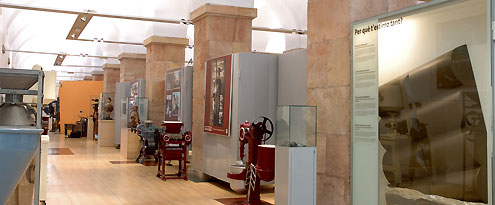
Machinery: A journey around the principal machines related to working with chocolate.

Barcelona Room: This is the area where you can see impressive chocolate figures and understand that they form part of Catalonia’s confectionery tradition.


Activities: The museum offers a wide range of activities, both for schools and for individuals, whether they are children or adults. Advance booking is necessary for all activities. 

Back : Old City East Tour

Fundació Francisco Godia


The Fundació Francisco Godia comprises in Barcelona one of the most important private art collections in Spain with over 100 works on display.


On Carrer Diputació, there is another building by Sagnier built in the same years as Casa Fargas, the Casa Garriga Nogués, which features corbels by Eusebi Arnau representing the ages of man, and stained glass windows on the piano nobile.

The Garriga Nogués family lived on the first floor until the Spanish Civil War broke out. It later housed a religious school and from 1986 was owned by Fundació Enciclopèdia Catalana, which carried out the initial renewal.

This building now hosts the Fundació Francisco Godia which comprises in Barcelona one of the most important private art collections in Spain with over 100 works on display and spans a broad period in art history, from the 12th century to the present day. 

The work performed to adapt the building to its current use by the Francisco Godia Foundation, converting it into a modern exhibition area, was directed by the architect Jordi Garcés, who had previously proven his skill in similar tasks - in particular the remodelling of the Picasso Museum in Barcelona.


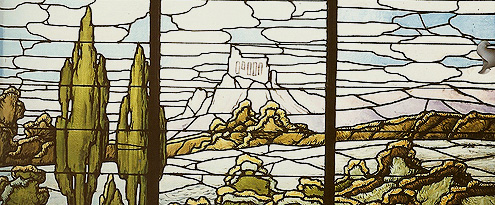
The first floor is given prominence by the balcony hanging over the entrance, supported by four large corbels sculpted by Eusebi Arnau. The ground floor, which is now used as a hall for temporary exhibitions, has a shed structure supported by tall cast iron columns that extends back into the middle of the block. Visitors reach the first floor by climbing the grand staircase. The interior of the first floor, which houses the Francisco Godia Foundation's permanent collection, has been totally restructured in an effort to return it to its original condition : the line of rooms which ends in a landscape window crafted by A. Rigalt y C. as well as the large dining hall and its green marble columns and gilt bronze capitals.

A large anthological exhibition of the Francisco Godia Foundation collection, the most complete to date, is on display to start off this new era: the most important works of medieval art, Baroque painting, brilliant and tragic Modernism, the refinement of ceramics, and 19th, 20th and 21st century art by Ramon Casas, Santiago Rusiñol, Nonell, Picasso, Joan Miró, Piero Manzoni, Karel Appel, Cristina Iglesias and Miquel Barceló.

Web site

Back : Quadrat d'Or Tour

Museu del Modernisme Català (Mmcat)

The new Museu del Modernisme opened in 2010. It is housed in a former textile factory designed by Eric Sagnier in the centre of Barcelona, and offers visitors the chance to enjoy a cultural centre dedicated exclusively to modernista art.


The holdings of the new Museu del Modernisme de Barcelona (MMCat) come from the private collection that two Barcelona antique dealers, Fernando Pinós and María Guirao, have amassed during their 40 years in the business. The museum is dedicated exclusively to Catalonia’s home-grown art-nouveau movement, modernisme. The collection on shows consists of 350 works by 42 of the most representative modernista artists, including Joan Busquets, Ramón Casas, Antoni Gaudí, Gaspar Homar, Josep Llimona, Joaquim Mir and Puig i Cadafalch, in their different disciplines: painting, sculpture, furniture and the decorative arts.

To mark the museum’s second anniversary,  new exhibits to further the work in the conservation and dissemination of modernisme have been added. The new exhibits include works by cabinetmakers and interior designers, such as the Busquets, Gaspar Homar, Francesc Jevellí and Antoni Gaudí; sculptures by Enric Clarasó, the Oslé brothers and the Masriera and Carreras studio. Other highlights include paintings by Ramon Casas, Joaquim Mir, Martí Alsina, Pere Borrell and other artists.

The Museu de Modernisme Català is housed in a centrally located modernista building designed by the architect Enric Sagnier. The Catalan vaults were restored and the original flooring on the ground floor preserved as part of the refurbishment project to house the museum. It has a floor space of 1,000m2. The top floor of the MMCat showcases the furniture and decorative arts and has a room dedicated to Antoni Gaudi. The ground floor displays paintings, sculptures and stained glass.

Back : Quadrat d'Or Tour

Museu Maritim

The Museum Marítim is located by the waterfront in one of Barcelona’s finest landmark buildings: the Reials Drassanes, the medieval shipyards which are a unique example of civic Gothic architecture. The royal arsenals date from 1378 and are the biggest and most complete Medieval dockyards in the world. The seafaring cities of Venice, Genoa, and Valencia all had impressive arsenals, but only vestiges remain. In contrast, Barcelona's shipyards, with their majestic arches, columns, and gigantic vaults, are a preciously intact. This complex, which before the coastline receded sat right on the water's edge, was used to dry-dock, construct, and repair ships for the Catalan-Aragonese rulers. During the 18th century, the place went into decline, mainly due to the dissolution of naval construction. Right up until the Spanish Civil War, it served as an army barracks.  MAP IT


The open space once used for shipbuilding is an ideal setting to display the collection which began as a small nautical museum in 1929. The museum is a gem for those who love Naval history.
Its collection titled "The Great Adventure of the Sea" is homage to Catalonia's maritime history. 
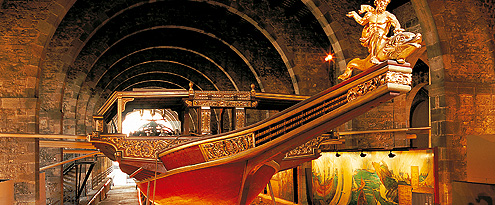
The most outstanding exhibit occupies an entire bay. It is a reconstruction of La Galería Real of Don Juan of Austria, a lavish royal galley, the original was used as the flagship in the important battle of Lepanto 1571. In 1971, following extensive documentation, this model was built in celebration of the vessel's most glorious achievement 400 years earlier. The ship headed an alliance of Spanish, Venetian, Maltese, and Vatican vessels in a bloody battle against a Turkish squadron. The so-called "Holy League" won, effectively ending Ottoman rule in the Mediterranean. There is an excellent film re-creating the battle, which you watch onboard, and you can view the galley's elaborate hull, hold, and deck where each of its 59 oars were manned by the sailors.

Other exhibits chart the traditional fishing techniques and sailing as sport through neat little caravels and draggers, snipes, and sloops. The art of wooden shipbuilding, the charting of the oceans, and the launch into the steam age are also covered. 

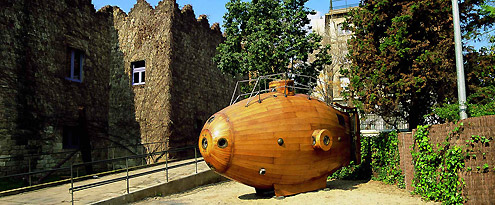
Particularly fine is the collection of late-19th-century mastheads, navigational instruments, and models of the Compañía Trasmediterránea's fleet (this local company still operates the Barcelona-Balearic islands route). The collection also boasts a small model of Ictíneo, one of the world's first submarines designed by the Catalan visionary Narcís Monturiol.

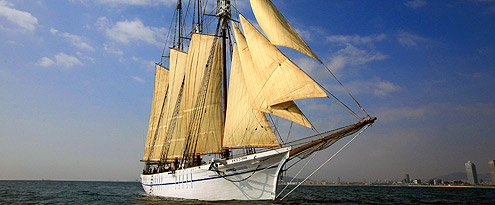
On Barcelona’s Moll de la Fusta quay, a few metres away from the Museu Marítim, the schooner, the Santa Eulàlia, is a wonderful example of a historic three-masted vessel, which has been restored to the delight of anyone wishing to learn a little bit more about our country’s seafaring past.  MAP IT

Barcelona’s Museu Marítim bought this historic and unique vessel at auction in 1997: at the time the ship was known as Sayrernar Uno. Following painstaking refurbishment, which faithfully restored its original appearance, the schooner was moored at the Moll de la Fusta quay in Barcelona’s old harbour, the Port Vell, and renamed in honour of one of Barcelona’s patron saints, Santa Eulàlia. This restoration project, which was the first of its kind in Spain, represented a step forward in disseminating our remarkable seafaring heritage. In addition to this, the restored schooner was also refitted as an operative vessel, meaning that it is not just a visitor attraction but also acts as a flagship for the museum when it sails the waters of the Mediterranean. 

This old ship, which was built in Torrevieja in 1918 and named Carmen Flores, is a wonderful floating ambassador for the museum, and a fine example of a three-masted schooner, which you can discover as you stroll along the quayside or, better still, climb aboard and find out about all the secrets of sailing.

Opening time: From April 1st to October 31st:
Tuesday to Friday, from 12pm to 7.30pm. Saturdays, from 2pm to 7.30pm. Sundays & public holidays, from 10am to 7.30pm.

Apparently it is also possible to navigate on this boatl every Saturday from 10 to 13, on reservation the day before at telèfon 933 429 920. 12€/adult. 
Museum web site  

Back : Rambla tour
Next : Palau Güell
Previous : Mirador de Colom