Affichage des articles dont le libellé est -Chic. Afficher tous les articles
Gòtic Tour
A stroll through Barcelona’s Gothic Quarter brings to light the early Roman city of Barcino and the medieval town with its palazzos, mansions and Gothic churches. This is the style that defines “the heart of Barcelona”: a neighbourhood where the splendour of the historic past coexists with the vibrancy of the present. (map)
Behind the cathedral, at the centre of the Roman city, today’s Gothic Quarter, marked by the point where the two main roads, Cardus ( today Carrer del Bisbe ) and Decumanus ( Carrer Llibreteria ), converged, we can still see the remains of the Roman Temple of Augustus (1). In fact, the original centre of Roman and medieval Barcelona still forms the core of 21st-century Barcelona. Its maze of narrow streets and squares is steeped in the city’s past and present.
Going around the back of the cathedral we will stop next at the 14th century Cloister (2), famous for its geese.Turning left we can visit Sant Sever Church (3), the only one in the city’s few Baroque-era churches to remain completely intact. On our left we discover the peaceful Plaça Sant Felip Neri (4), a tiny square with a charming little fountain. Going back toward the center we will pass by The Palau Episcopal (5)
which adjoins the cathedral on the west. The two round towers on the Portal del Bisbe date from Roman times and the inner courtyard, with its Romanesque arcades from the 14th century. On the other side, stands the entrance to the Casa de l’Ardiaca (6), or Archdeacon’s House, which contains interesting archaeological remains of the ancient Roman wall of Barcelona.The passage between these 2 buildings marks one the gates in the ancient wall and opens on Plaça Nova (7) which was the site of the city’s hay market in the middle age.
Next on the right, on the Pla de la Seu, the Cathedral de la Santa Creu i Santa Eulàlia (8) reflects the different generations who have left their imprint and the blend of architectural styles in this predominantly Gothic building which needs to be viewed inside in order to fully understand its splendour. Adjacent to the Cathedral stands the Casa de la Pía Almoina (9), with two sections, the Gothic one was built around 1435, and the Renaissance one added in 1546, currently holds the Diocesan Museum.The narrow street on the east side of the Cathedral leads to the Verger del Palau Reial (10), the garden of the former Royal Palace of the Counts of Barcelona. One building of this Palace now hosts the Museu Frederic Marès (11) which includes an extensive and valuable collection of art works and everyday objects from the 15th to 19th centuries. On the same street, the next building is the 16th-century Palau del Lloctinent (12), or Lieutenant’s Palace, which has a beautiful Renaissance courtyard and is currently home to the Archive of the Crown of Aragon. On the other side, this Palace, the Palau Reial and the 14th-century royal chapel of Santa Àgata form the Conjunct Monumental de la Plaça del Rei (13) which is, arguably, the Gothic architectural ensemble that best exemplifies the city’s medieval past. The royal palace, the Palau Reial Major, and its surrounding buildings, enclose a harmonious and peaceful square which is still imbued with Barcelona’s splendour during the Middle Ages. Below the square, you can visit the impressive archaeological remains of Roman Barcino.
Leaving la Plaça del Rei, we cross la Plaça Ramon Berenguer El Gran and head southeast toward la Plaça de l'Angel. To the right, just off the wide main street leading to the southeast, can be seen remains of the old town wall, on which stands the Palau de Requesens. We now turn right into la Carrer Llibreteria, one of the oldest street of Barcelona, turn left into la Carrer de la Dagueria and reach l'Eglesia Sants Just i Pastor (14), supposedly the oldest remaining church of the city. Following la Carrer d'Hercules, on the right side of the church, we reach now the City Hall (15) and the seat of the Catalan Government, the Palau de la Generalitat, and the Plaça de Sant Jaume (16), right in the middle of this Barcelona neighbourhood, the end of this tour. Very near the Plaça de Sant Jaume, is the old Jewish Quarter, the Call Jueu, with its endless narrow streets, where some remains of the ancient synagogue still survive.
Montjuïc tour
Compared to the booming street life, the human warmth, hustle, and bustle of Barcelona, Montjuïc may feel remote, but the art and architecture concentrated around this lush promontory, covered with parks and gardens, more than justify spending a day of exploring the following 14 sites to visit on this walking tour. MAP IT
But before we start let's have a special thought for our Celt, Jewish and Roman ancestors :
Several thousand years ago, Iberic Celts settled on the Montjuïc, a 173 meter high hill southeast of Barcelona's current city center. The hill was later used by the Romans as a ceremonial place.
This hill overlooking the south side of the port is said to have originally been named Mont Juif for the Jewish cemetery once on its slopes, though a 3rd-century Roman document referring to the construction of a road between Mons Taber (around the cathedral) and Mons Jovis (Mount of Jove) suggests that in fact the name may derive from the Roman deity Jove, or Jupiter.
Amen.
The most spectacular way to reach the Castle and other attractions at Montjuïc is via the cable car that crosses the port : the Transbordador Aeri. You've seen what it's like and, let's say, you would prefera less vertiginous experiment ? No problem, a funicular land-based service climbs the hillside from Paralell Metro station in Poble Sec, and makes a final stop immediatly below the castle at the top of Montjuïc. Or we could climb on bus 150 that connects all the sites of Montjuïc with the Plaça d'Espanya Metro station.
The eastern side of the hill is almost a sheer cliff, giving it a commanding view over the city's harbor and of the Mossèn Costa i Llobera Gardens immediately below. The collection presented by these gardens is considered one of the most important in the succulent plant world. But it is a little off the road and I suggest we start our day in Montjuïc at the top of the hill (a height of 173 meters) which was the site of several fortifications, the latest of which, the Castell de Montjuïc (1), remains today. The Mirador de l'Alcalde (2), the Mayor's Viewing Point, a garden located on the mountain of Montjuïc very near the castle at the top, honours its name by the exceptional views of Barcelona it provides. Going down, we will go through the Gardens of Joan Brossa (3) and the lush Jardins de Mossèn Cinto Verdaguer (4).
Montjuïc is now Barcelona's art enclave, with nearly every painting in town hanging in the Miró Foundation (5) or the Museu Nacional d'Art de Catalunya ( MNCA ). Opposite the main entrance to the MNCA the impeccably maintained gardens known as the Jardins Maragall (6), in which stands the Palau Albeniz, built in 1929 and with murals by Salvador Dali, was named after the Catalan poet Joan Maragall i Gorina (1860-1911).
More recently, the 1992 Olympic Games brought about major renewal. The Olympic Ring (7), the main site of the Olympic Games, features the stadium, the Estadi Lluís Companys, Arata Izosaki’s sports palace, the Palau Sant Jordi, and the telecommunications tower designed by Santiago Calatrava. Nearby, the Museu Olímpic i de l'Esport Joan Antoni Samaranch and the Botanical Gardens are also unmissable sights as you explore the Parc de Montjuïc.
Amen.
The most spectacular way to reach the Castle and other attractions at Montjuïc is via the cable car that crosses the port : the Transbordador Aeri. You've seen what it's like and, let's say, you would prefera less vertiginous experiment ? No problem, a funicular land-based service climbs the hillside from Paralell Metro station in Poble Sec, and makes a final stop immediatly below the castle at the top of Montjuïc. Or we could climb on bus 150 that connects all the sites of Montjuïc with the Plaça d'Espanya Metro station.
The eastern side of the hill is almost a sheer cliff, giving it a commanding view over the city's harbor and of the Mossèn Costa i Llobera Gardens immediately below. The collection presented by these gardens is considered one of the most important in the succulent plant world. But it is a little off the road and I suggest we start our day in Montjuïc at the top of the hill (a height of 173 meters) which was the site of several fortifications, the latest of which, the Castell de Montjuïc (1), remains today. The Mirador de l'Alcalde (2), the Mayor's Viewing Point, a garden located on the mountain of Montjuïc very near the castle at the top, honours its name by the exceptional views of Barcelona it provides. Going down, we will go through the Gardens of Joan Brossa (3) and the lush Jardins de Mossèn Cinto Verdaguer (4).
Montjuïc is now Barcelona's art enclave, with nearly every painting in town hanging in the Miró Foundation (5) or the Museu Nacional d'Art de Catalunya ( MNCA ). Opposite the main entrance to the MNCA the impeccably maintained gardens known as the Jardins Maragall (6), in which stands the Palau Albeniz, built in 1929 and with murals by Salvador Dali, was named after the Catalan poet Joan Maragall i Gorina (1860-1911).
More recently, the 1992 Olympic Games brought about major renewal. The Olympic Ring (7), the main site of the Olympic Games, features the stadium, the Estadi Lluís Companys, Arata Izosaki’s sports palace, the Palau Sant Jordi, and the telecommunications tower designed by Santiago Calatrava. Nearby, the Museu Olímpic i de l'Esport Joan Antoni Samaranch and the Botanical Gardens are also unmissable sights as you explore the Parc de Montjuïc.
The Historic Botanic Garden (8) , a little treasure among the gardens of Barcelona, is nestled in the site of two old quarry pits in the Foixarda sector of Montjuïc, behind the MNAC. The Museu Nacional d'Art de Catalunya (9) contains what is considered the world's best collection of Romanesque murals and frescoes removed for restoration from Pyrenean chapels in the 1930's. In addition, the MNAC is the home of the Art Modern collection of impressionist and Moderniste painters, as well as an impressive Gothic collection. Before or after the visit, depending on the time, we could have a nice lunch at the Oleum a beautiful restaurant located inside the MNCA with a superb view over Barcelona.
Montjuïc Hill has borne witness to, and been the focus of key events that have shaped its personality. The first such event was the 1929 International Exhibition held in Barcelona which fostered the development of the zone ( the MNAC is housed in the colossal Palau Nacional, the centrepiece of the 1929 exhibition ). The Poble Espanyol (10), with its “artisans’ village”, was built to show visitors a representative sample of Spanish architecture. The Pavelló Mies van der Rohe (11), which was the German pavilion at the event, is a superb example of Bauhaus architecture.
Just across the street, the former Casaramona textile factory (12), a modernista landmark by Puig i Cadafalch, is now home to CaixaForum, a cultural centre which hosts temporary exhibitions. At the foot of the Palau Nacional the Magic Fountain (13) was built for the 1929 Universal Exhibition. When active, it constantly changes color and shape offering a spectacular display of music, water acrobatics and lights which generate over 50 kinds of shades and hues...
By now we should be exhausted, ready to go back to our hotel. No ? OK let's do some shopping ! But in an unusual place : Arenas (14)
Just across the street, the former Casaramona textile factory (12), a modernista landmark by Puig i Cadafalch, is now home to CaixaForum, a cultural centre which hosts temporary exhibitions. At the foot of the Palau Nacional the Magic Fountain (13) was built for the 1929 Universal Exhibition. When active, it constantly changes color and shape offering a spectacular display of music, water acrobatics and lights which generate over 50 kinds of shades and hues...
By now we should be exhausted, ready to go back to our hotel. No ? OK let's do some shopping ! But in an unusual place : Arenas (14)
Mossèn Costa i Llobera Gardens
The collection presented by the Mossèn Costa i Llobera Gardens is considered one of the most important in the succulent plant world. Classifications aside, this garden of arid plants, little given to dalliance, has the capacity to dazzle the visitor with its great quantity and variety of cacti and tropical plants.
This garden is not anything like urban gardens, nor the other gardens found in the city. It does not have children's play areas or dog runs, but it does not need them. Its views over the sea and its own vision are enough. More than a green space to relax in, read in the open air or play, it is a museum to visit that will surprise you with the great variety of shapes and sizes that these fleshy, water retaining plants can adopt.The layout of the garden is perfect for gazing at groups of plants. Its sloped topography is sectioned off by paths that run parallel to the elevation of the land and are joined by short stairways and changing directions. MAP IT
The gardens were created at the end of the sixties, they are located in a space that was once occupied by anti-air batteries.
The gardens have been dedicated to collecting and exhibiting cacti and other succulent and tropical plants from the beginning, as its orientation (Miramar area, south east) and slope favour this type of plant life. In the thirties there were some old plantations in the area that were dedicated to these plants and that served as an example and driving force to later create the garden. At the height of its splendour, the garden held up to 800 different species.
The initial spirit of the garden's aesthetics and the distribution of the species with a decorative order were recovered during a restoration carried out in 2006 and 2007. In some cases, species were recovered, such as the Oreocereus neocelsianus. Likewise, new plants are being incorporated that did not exist before, such as the Xanthorrhoea and Floss Silk trees (Chorisia speciosa).
The gardens pay homage to the poet Miquel Costa i Llobera with the sculpture L'au dels temporals by Ros i Bofarull; to the professor Joan Pañella with a monolith by Txell Duran; and to local tradition with the realist bronze figure La puntaire by Viladomat.
Vegetation
The southeastern orientation, facing the sea, creates a microclimate that enables having a great diversity of woodlands and shrubbery that cannot be found in other areas of Barcelona, as is the case with the Ficus (Ficus sp), Whiteflower Kurrajong (Brachychiton populneus), Australian Silver-Oak (Grevillea robusta), Bauhinia grandiflora, etc. It also enables the presence of many sub-tropical succulent plants, among which there is an important collection of cacti of all shapes and sizes: tall columns, globe-shaped, straight, inclined, lone and grouped together. Each one flowers following its biological cycle, with individual colours and shapes. In addition, the gardens have a collection of Mediterranean and acclimatised plants such as Carob trees (Ceratonia siliqua) and Olive trees (Olea europaea). Palm tree species are also quite notable.
Back to : Montjuic Tour
Source : Garden web site
Old City East Tour
During the Middle Ages La Ribera (the shore) was known as Barcelona’s wealthiest neighborhood. Handsome medieval mansions line the narrow streets; one of them is home to the popular Picasso Museum. Today the area closest to the sea remains affluent and lively. Fashionable bars, galleries, shops and restaurants can be found here, especially along the main thoroughfare, “Passeig del Born”, which has led to the area near the seafront being referred to simply as “El Born”.
Barceloneta is home to one of Barcelona's liveliest beaches as well as some of the best seafood restaurants to be found in the city. At night the seaside booms to the sound of the numerous, lively beach-side bars and cafes that are found here.
The route is materialized on the map by a purple line, leading to the points of interest mentioned below. It includes 7 major sites, each represented on the map by a dark rectangle, and which have in this blog their own page of description and pictures, accessible by clicking on their name. Each of these pages has a "back" link at the end to return to the tour page. All these pages can be selected by clicking the "Old City East Tour" label in the right column of the blog". The other links open in a new tab/window the maps, pictures,pages external to this blog.
Plaça de l'Angel. Known in medieval times as the Plaça del Blat ("Square of Wheat"), since all grain sales were made here, this small, atmospheric square stands at the busy junction of Jaume I and Laietana on the eastern edge of the Barri Gòtic.
From the Plaça de l'Angel take Carrer Boria right; then turn left into Carrer Mercaders and immediately right again to Plaça Santa Caterina.
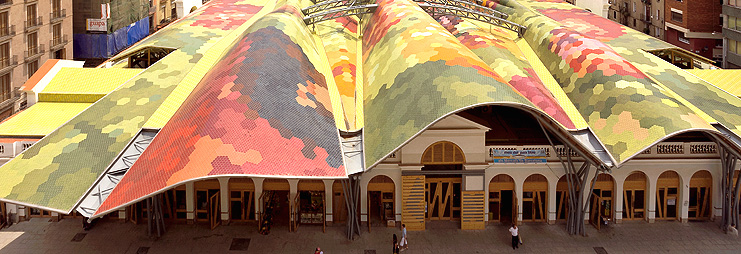
Plaça Santa Caterina. The oldest working market in the area, Mercat de Santa Caterina (1), occupies the original site of a medieval convent, and provides the usual rich cornucopia of Mediterranean produce. In 2005, after a protracted period of renovation, the market was reopened with a stunning new moderniste design, whose colorful waved roof owes more than a little to Gaudí. It's open every day except Sunday.
From the south-facing side of the market take Carrer Sant Jacint, turn right into Carrer Corders, and then south into the Placeta d'en Marcus.
Placeta d'en Marcus. Well worth a peek is th diminutive 12th-century Capella d'en Marcus, nestling in this tiny Placeta, near the junction of calles Montcada and Carders (the latter means "Woolcomber's Street"). Originally conceived by one Bernat Marcus as a sanctuary for luckless travelers who reached the city after the gates had been closed, the chapel may have been headquarters of the country's very first postal service.
Continue south across Carrer Princesa to reach:
Carrer Montcada. Named after a powerful merchant, Guillem de Montcada, who in 1153 built a long-since-disappeared palace here, this charming medieval street would be interesting enough to stroll along even if it didn't contain some of the city's most interesting museums. The elegant buildings lining the street are reminders of the time it was a wealthy trading center; vast fortunes were made here by adroit and ambitious merchants.
Carrer Montcada, 15-21. Located in no fewer than five former palaces in Carrer Montcada, the Museu Picasso (2) is generally rated the most popular museum in town. In essence it covers the artist as a young man, and even the older works on display were created when the Malagueño was a mere 20-something. Exhibits range from notes and rough sketches to lithographs, ceramics, and oil canvases. Highlights are Las Meninas (his take on Velázquez's painting of the same name) and The Harlequin; although time will be short, keep an eye open for La Ciencia y la Caridad (Science and Charity), a masterpiece created while Picasso was at school.
Carrer Montcada, 12. The Palau del Marquès de Lió has been the residence of several local noble families, among which the Marquès de Lió, which today gives its name to the building. It is one of the venues of the Disseny Hub Barcelona (design hub) and hosts the temporary exhibitions of the Museu Tèxtil i d'Indumentària, The oldest preserved part is a tower and two coffered ceilings dating from the late thirteenth century.
Carrer Montcada, 14. Atmospherically housed in the 15th-century Palau Nadal, close to the above two museums, the Museu Barbier-Mueller d'Art Precolombí, a branch of the great Geneva museum, used to offer one of the best displays of pre-Columbian art and has been drawing in the crowds ever since it opened in 1997. Among its highlights was a dazzling selection of gold, jewelry, and masks. Unfortunately it closed on September 14, 2012
Continue down Carrer Montcada to the Passeig del Born. Turn right onto Carrer de Santa María.
Plaça de Santa María. Built in the 14th century during a period of just over 50 years (quick for the time), the grandiose, high-vaulted basilica Santa María del Mar (3), honoring the patron saint of sailors, used to stand on the city's shore when the sea reached further inland. As the welfare of sailors mainly depended on the clemency and protection of "Our Lady of the Sea," in those days large numbers of penniless people helped without pay on its construction. Bronze figures of two porters on the door commemorate this, and the west portal is flanked by statues of Peter and Paul.
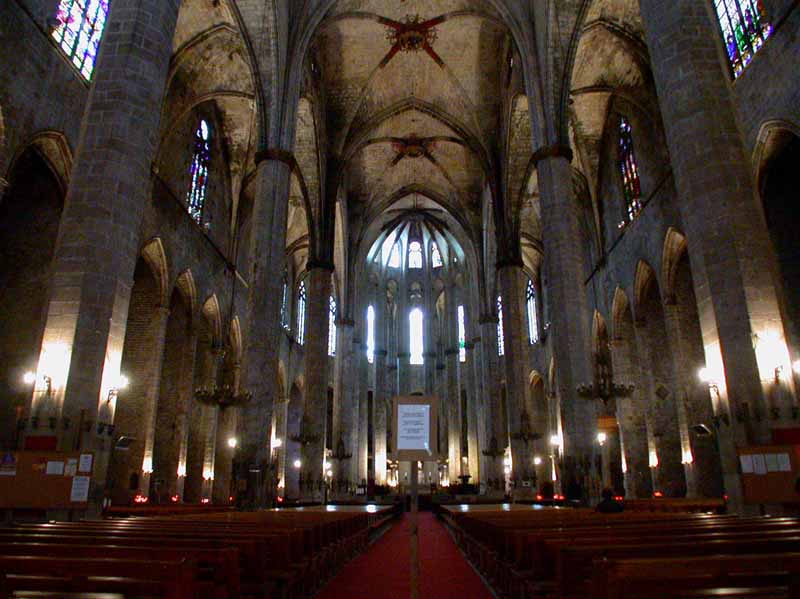
Today it's one of Barcelona's most imposing Gothic structures, noted for its soaring columns and uncluttered aura of space. Look out for the superb stained-glass windows, particularly the 15th-century rose-shaped one above the main entrance. A belated 1997 addition to this is, in contrast, jarringly unimpressive. You'll want to return for an evening concert -- particularly a performance of Handel. In such a timeless setting it's an unforgettable experience.
Go back to the:
Passeig del Born. This short wide paseo, or avenue, was once a center for tournaments and jousting events. (The name "Born" in Catalan means, among other things, the point of a jousting lance.) In medieval times, when Catalonia was a major naval power, the paseo's fame was such that the saying Roda el món i torna al Born ("Go around the world and return to the Born") became widespread. It was the spiritual heart of the city from the 13th century right up to the 18th century, when La Rambla took over the number-one spot. Today the Born's revelry assumes a more modern nocturnal form, centered mainly around the countless bars and cafes filling the bustling side streets.
Passeig del Born, at the corner of Carrer de Flassaders, is the famous Hofmann Pasteleria- a magic corner with gorgeous cakes and colourful pastries inviting you to come in, try and return.
At the end of the avenue the Antic Mercat del Born (4), a massive building, with its wrought-iron roof, was formerly one of the city's biggest wholesale markets.
Turn left on Carrer del Comerç:
Comerc, 36. A whole museum devoted to the love and learning of the history of chocolate ? Yes the Xocolata museum (5) !
At the end of the street turn right to go to the :
Parc de la Ciutadella (6). Built on the site of a much-hated 18th-century Bourbon citadel, which was destroyed in 1878, this 30-hectare (75-acre) oasis of relaxing greenery came about in the late 1890s after serving as the site for the Universal Exhibition. Its many highlights include statues, fountains (one designed by a young Gaudí), a boating lake, a waterfall (La Cascada) with a giant hairy mammoth sculpture, the Domènech i Muntaner-designed Castell dels Tres Dragons (Castle of Three Dragons), which houses the zoological museum, two arboretums, and a small botanical garden. There's also a science museum and -- last, but not least -- the Catalan parliament, which is located in the former citadel's arsenal and can be visited by appointment. At the northern end of the park, the moderniste-cum-neo-mudéjar-style Arc de Triomf, served as the entrance to the Universal Exhibition.
Exit the park from the south corner.
Avinguda Marquès de l'Argentera. Following this avenue you will pass in front of the old train station, The Estació de Fança . Build in 1926, this elegant station worthy of the first line connecting Barcelona and France, comprises two main sections: the train shed and the lobby. There is a curved glass and metal canopy over the 12 tracks and seven platforms, a fine example of wrought-iron architecture, filling the train shed with natural light and creating a spacious area.
In the Estació, the same is true of the noucentista-style lobby, creating a spacious area ideal for all kinds of activities. The lobby and buildings around the tracks were constructed from luxury materials, including marble and bronze, which give the station its characteristic ornate appearance.
At the end of the avenue turn left to enter Barceloneta.
Barceloneta. The Barceloneta is a triangular spit of land that cuts into the sea the old harbour, or Barcelona’s Port Vell, on one side, and sandy beaches on the other. The neighbourhood, with its narrow, rectilinear streets, was built on a military grid structure to provide accommodation for the former inhabitants of La Ribera who had lost their homes due to the construction of the citadel. The houses were low-rise and small in scale so as not to obstruct views of the city. The former general warehouse in the old port, the Port Vell, which was built in 1901 and is known as the Palau del Mar, host the Museu d'Història de Catalunya. The permanent exhibition traces the history of Catalonia from its distant roots to the present day in an interactive and innovative way. The Museu d'Història de Catalunya layout is structured chronologically, in eight areas, set out on four floors.
It is now one of the city’s most visited and popular districts. In 1988, in pre-Olympic days, the decision was taken to demolish the old beachfront restaurants, known as xiringuitos, and public baths, heralding a process of opening the city up to the sea and the modernisation of an area which now offers first-class beaches as the main attraction for its visitors.
On the sand and inside the neighbourhood, rows of restaurants and bars combine with the traditional images of locals sitting in their chairs in the street and narrow balconies displaying clothes drying in the sun.
Sources : Frommer's BarcelonaTurisme
Barceloneta. The Barceloneta is a triangular spit of land that cuts into the sea the old harbour, or Barcelona’s Port Vell, on one side, and sandy beaches on the other. The neighbourhood, with its narrow, rectilinear streets, was built on a military grid structure to provide accommodation for the former inhabitants of La Ribera who had lost their homes due to the construction of the citadel. The houses were low-rise and small in scale so as not to obstruct views of the city. The former general warehouse in the old port, the Port Vell, which was built in 1901 and is known as the Palau del Mar, host the Museu d'Història de Catalunya. The permanent exhibition traces the history of Catalonia from its distant roots to the present day in an interactive and innovative way. The Museu d'Història de Catalunya layout is structured chronologically, in eight areas, set out on four floors.
It is now one of the city’s most visited and popular districts. In 1988, in pre-Olympic days, the decision was taken to demolish the old beachfront restaurants, known as xiringuitos, and public baths, heralding a process of opening the city up to the sea and the modernisation of an area which now offers first-class beaches as the main attraction for its visitors.
On the sand and inside the neighbourhood, rows of restaurants and bars combine with the traditional images of locals sitting in their chairs in the street and narrow balconies displaying clothes drying in the sun.
Sources : Frommer's BarcelonaTurisme
Santa Caterina Market
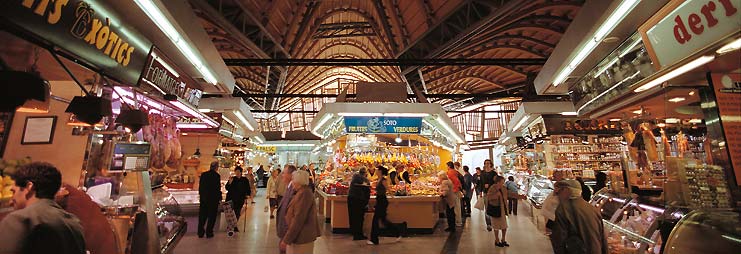
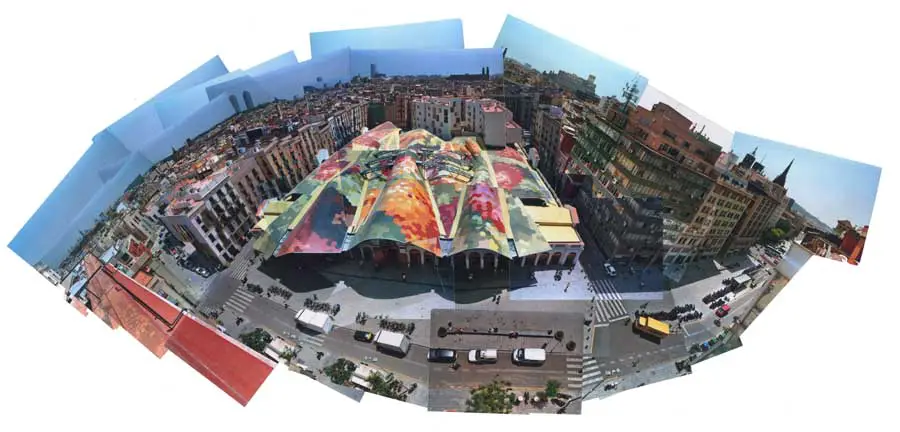
From the Barcelona Cathedral, an undulating, brightly coloured roof catches our eye. Attracted like insects to a colourful flower, we approach to discover a food market below the roof: the Santa Caterina Market. The original design of the building, as well as the treasure trove of produce displayed on its stalls, won’t disappoint visitors to the neighbourhood of Santa Caterina.
| Santa Caterina Market X |
The spacious, modern market building was constructed on the former site of the Convent of Santa Caterina, from which it takes its name. During the post-Civil War period, Santa Caterina became the main food supplier to the towns on the outskirts of Barcelona. People from Sant Adrià, Santa Coloma and Mataró came on the tram to buy food in this market in times of shortage.
(...) The design commission went, in 1997, to the highly imaginative Catalan practice EMBT, the husband and wife team of Enric Miralles and Benedetta Tagliabue.
Construction took so very long not because of political wrangling and rows over cash, but because of a combination of a complex brief and what was unearthed here.
The architects were asked to squeeze together the revived market, the plan of which was constantly changing, a museum, two blocks of 59 low-rent social housing for senior citizens, an ambitious underground car park for articulated lorries serving the market and 250 cars together with an "organic waste depository" for the Santa Caterina and La Ribera districts of the city centre. All of which is rather like being asked to erect a circus Big Top in the kitchen while builders are busy working on the rest of your house. And the garden shed, too.Somehow, all these disparate elements fit together happily, as these things do in Barcelona; but, to make life more difficult, and interesting, for everyone involved, building works on the market uncovered the foundations of a substantial Dominican monastery that had been torched by anti-clerical Catalan revolutionaries in 1835.
Alongside these were the remains of what is thought to be the first wholly Gothic church in the city, dating from 1241, and, to keep the archaeologists digging, ruins of a late Roman necropolis. The market nailing a lid on these ghosts of the city's past was built between 1844 and 1848. A century and a half later, this building was creaking like some antique ship well past her sail-by date, which is where EMBT came to the stuttering, halting rescue. (...) (The Guardian)
EMBT has received many accolades for their management of the historic building’s renovation. In addition to leaving some parts of the remaining apse of the monastery exposed, the architects were determined to take advantage of the original structure in order to preserve its historic relevance. As residents of the neighborhood themselves, Enric Miralles and Benedetta Tagliablue were determined to “regenerate” the dilapidated market instead of completely demolishing the building, something so often seen in historic centers of European cities.
| Santa Caterina Market X |
EMBT kept the original white masonry walls with multiple arched openings on three sides. The fourth side was reimagined to open into a plaza surrounded by social housing buildings that were also part of the urban renewal plan. Much of the second story exterior is covered in awkwardly hung movable shutters – one of the many playful touches typical of an EMBT design.
Today, Barcelona’s Santa Caterina Market is a busting hub of activity set in a modern design that pays homage to the building’s origins. By editing the existing features of the market, EMBT adeptly gave life back to an aging icon and boosted the local culinary economy as well. Mixing Spanish tradition with a funky design and fresh food is a fitting tribute for this cosmopolitan city, one of the culinary capitals of the world.
The refurbishment of Barcelona’s first covered food market was completed in 2005. The old Santa Caterina food market revealed a gleaming, undulating and brightly coloured roof designed to be seen from the air. The roof is attached to the building by a wooden structure, and a vast mosaic of coloured ceramic pieces, representing fruit and vegetables, boldly breaks with the traditional look of a market. The market has always been characterised by a desire to innovate. Santa Caterina Market was built in 1845 to provide the neighbourhood’s blue-collar community with foodstuffs. (barcelonaturisme).
Back : Old City East Tour
Museu Picasso
The Museu Picasso is housed in five Catalan-Gothic-style palazzos dating from the 13th and 14th centuries, and opened to the public in 1963. It is now an essential museum for anyone wanting to find out about the artist’s formative years.
The original house dates from the 13th century, with major renovations being undertaken between the 15th and 18th centuries.During the 13th and 14th centuries, the palace belonged to several noble families from the court of Aragón. It was bought by the Coromines-Desplà in 1386, members of the Barcelona haute-bourgeoisie who, in 1400, sold it to the merchant Berenguer d’Aguilar.
Successive generations of the Aguilar family refurbished the property, leaving traces of very diverse styles. The palace passed to the Clerch and Pons families in 1837 and finally, on November 3rd 1953, Barcelona City Council bought it, carrying out extensive restoration work due to the building’s terrible state-of-repair.
The central courtyard with the open-air stairway, pointed arch gallery and flamboyant Gothic sculptures dates from the 15th century. There are coffered ceilings on the first floor.
The remains of a large late 13th century fresco are conserved, evoking the conquest of Majorca by Jaume I in 1229. The mural was uncovered during restoration work in the ‘60s, on removing the wall coverings in one of the galleries and was moved to the Museu Nacional d'Art de Catalunya, where it is housed today.
In the mid-18th century, the Baron of Castellet ordered a neo-classical room be built with marble elements and polychrome motifs, a mix of classical and baroque elements lending the room the sumptuousness of European classicism. Upon his death in 1831, the baron left it to Santa Creu Hospital.
A palace from the 13th-14th centuries that was heavily renovated in the 18th like the other palaces on the street. It is set around a central courtyard in the mediaeval style with preserved coffered polychrome mediaeval ceilings and 19th century decorative ceilings on the main floor. The oldest known documentation shows that the palace was owned by Jaume Caveller – head councillor at Barcelona City Council – in 1349. His daughter Felipona married the politician Ramon Desplà and their son, Ramon Desplà i Cavaller, made the Desplà Palace the most important building of the entire block of houses.
It passed into the hands of the Cassadors or Caçadors and their heirs in the 16th century, the Marquises of Ciudadella, the first of whom was Josep Meca i Caçador who gave his name to the palace. His widow sold the house to the merchant Segimon Milans in 1719. The Milans family orchestrated the major renovation of the building which had been largely destroyed by the 1714 bombardment.
The Picasso Museum in Barcelona is a key reference for understanding the formative years of Pablo Ruiz Picasso. The genius of the young artist is revealed through the 4,249 works that make up the permanent collection. Furthermore, the Museu Picasso, opened in 1963, also reveals his deep relationship with Barcelona: an intimate, solid relationship that was shaped in his adolescence and youth, and continued until his death.
Jaume Sabartés, Barcelona now has the youthful work of one of the twentieth century’s most significant artists.The history of the Picasso Museum in Barcelona is the chronicle of the artist’s firm wish to leave the imprint of his art in our city. Thanks to the wishes of Picasso and his friend and personal secretary,
The Museum is very rich in regard to work from the training periods in the life of the artist; we could say that it is practically exhaustive up to the Blue Period, of which the Museum has a priceless group of works.
Furthermore, the Museum houses an important representation of works from 1917, and the series, Las Meninas (1957) and a very large Picasso’s prints collection, now displayed in the rooms opened in the beginning of 2008.
Sources : Museu Picasso
Palau Aguilar Montcada, 15
The central courtyard with the open-air stairway, pointed arch gallery and flamboyant Gothic sculptures dates from the 15th century. There are coffered ceilings on the first floor.
The remains of a large late 13th century fresco are conserved, evoking the conquest of Majorca by Jaume I in 1229. The mural was uncovered during restoration work in the ‘60s, on removing the wall coverings in one of the galleries and was moved to the Museu Nacional d'Art de Catalunya, where it is housed today.
Palau del Baró de Castellet Montcada, 17
A mediaeval Palace in origin, it underwent profound renovation work in the 18th century. Set around a central courtyard in the mediaeval style, the façade conserves a 16th century religious motif and to the inside, a marvellous neo-classical room on the main floor. The history of the owners dates back to the 13th and 14th centuries. The Gerona family owned the palace in the 15th century and it was occupied by several Catalan aristocratic and bourgeois families from the 16th to 18th centuries between sales and inheritances.
It received its name from the title awarded in 1797 to the owner and renovator of the building Marià Alegre d’Aparici I d’Amat by King Carles IV.In the mid-18th century, the Baron of Castellet ordered a neo-classical room be built with marble elements and polychrome motifs, a mix of classical and baroque elements lending the room the sumptuousness of European classicism. Upon his death in 1831, the baron left it to Santa Creu Hospital.
In the second half of the 19th century, the building was rented by different tenants until it was bought by the Rius family. In the 1950s, it passed into the hands of Barcelona City Council.
Palau Meca Montcada, 19
It passed to the Sisters of Christian Doctrine with the Santa Madrona friendly society being set up in 1901, later becoming part of a banking institution’s benevolent fund. The latter and Barcelona City Council signed a transfer agreement for the palace on 5th December 1977 and, thanks to this agreement, the renovation and extension project at the Picasso Museum was begun in 1981, opening to the public officially on 11th January 1982. The renovation served to connect the Meca Palace to the Aguilar and Baró de Castellet palaces.
Casa Mauri Montcada, 21
A building from the 18th century set around a courtyard. The house was partially built over Roman era structures belonging to one of the towns in the outskirts of Barcino colony. The façade has a small wooden truss – a characteristic 18th century enclosure system which is practically the only one remaining in Barcelona. It is possible that the house once formed part of the neighbouring Meca Palace outbuildings in the 13th century. Between 1378 and 1516, it belonged to the Rocha family with documentation missing until 1716, when it was inhabited by F. Casamada.
The building underwent many renovations, the most important in 1872 when it was joined to the neighbouring house, the palau Finestres, owned by Josep Vidal i Torrents. From that moment, a large part of the building was given over to industrial purposes. In 1943, it was purchased by Mauri confectioners. It became a part of the Picasso Museum in 1999.
Palau Finestres Montcada, 23
As with the rest of the palaces that constitute the Picasso Museum, the Finestres Palace retains original buildings from the 13th century. The building was built atop the remains of a necropolis dating from the end of the Roman era. The house is set around a large courtyard with the characteristic outdoor stairway leading to the main floor. The ground floor preserves a series of rooms with exquisite arcades. The first floor houses two large triple windows with windowpanes or columns. It preserves a magnificent coffered ceiling from the late 13th / early 14th centuries which has been restored. The top floor has an elevation and open or sun gallery.
The most important reforms were undertaken in the 15th and 17th-18th centuries when the round arch gallery crowning the inner courtyard was added.
The building belonged to the Marimon family from 1363 to 1516. In 1698, it passed to the Dalmases family, owners of the Dalmases Palace at Number 20, Carrer de Montcada. In 1872, Josep Vidal i Torrents bought the property and attached it to casa Mauri. Barcelona City Council purchased it in 1970 and it is presently used to house temporary exhibitions at the Picasso Museum. | Harlequin, 1917 - Oil on canvas |
| Portrait of Jaume Sabartés, sitting |
The Museum is very rich in regard to work from the training periods in the life of the artist; we could say that it is practically exhaustive up to the Blue Period, of which the Museum has a priceless group of works.
| Las Meninas (infanta Margarita María), 1957 |
Furthermore, the Museum houses an important representation of works from 1917, and the series, Las Meninas (1957) and a very large Picasso’s prints collection, now displayed in the rooms opened in the beginning of 2008.
The Museum has undergone successive renovations and expansions, and it’s currently starting to develop new programmes, activities and services to become a reference place, envisaged to spreading knowledge and to fostering the visitor’s participation and critical views. The Museum wishes to be a dialogue space, exploring new approaches to Picasso’s work and influence and offering new perspectives on the Museum Collection.
Back : Old City East Tour
Sources : Museu Picasso
Santa Maria del Mar
The basilica of Santa Maria del Mar in Barcelona, also known as the “cathedral of La Ribera”, is one of the most perfect examples of Gothic style architecture due to its harmonious proportions and the serenity of the ensemble. The basilica of Santa Maria del Mar was the place of worship for the shipwrights and merchants of Gothic Barcelona.
From the 4th to the 6th century there used to be a Roman necropolis, which was discovered during the excavations in the sixties, in the place where the church stands today. The first mention of a church of Santa Maria by the sea dates from 998.
In the Middle Ages, the long periods of time it took to build a church – often more than a century – usually involved changes in architectural style. Santa Maria del Mar in Barcelona is an exception. It was built in just 55 years, from 1329 to 1384, and is the only surviving church in the pure Catalan Gothic style.
The construction of the present building was promoted by the canon Bernat Llull, who was appointed Archdean of Santa Maria in 1324. Construction work started on 25 March 1329, when the foundation stone was laid by king Alfonso IV of Aragon (III of Catalonia), as commemorated by a tablet in Latin and Catalan on the façade that faces the Fossar de les Moreres.The architects in charge were Berenguer de Montagut (designer of the building) and Ramon Despuig, and during the construction all the guilds of the Ribera quarter were involved. The walls, the side chapels and the facades were finished by 1350. In 1379 a fire damaged important parts of the works.
Finally, on 3 November 1383 the last stone was laid and on 15 August 1384 the church was consecrated. In 1428 an earthquake caused several casualties and destroyed the rose window in the west end.
In the Spanish war of succession, the church was partially destroyed in 1714. The damage was repaired just barely. In the Spanish Civil War in 1936 a fire reeked mass devastation. The fire had largely damaged the interior, the images and the Baroque altar were destroyed. A large part of the stained-glass windows had to be reconstructed. The chapel of the Blessed Sacrament, adjacent to the apse, was added in the 19th century. In 1990 the renovation and restoration work has been completed.
The novel "Cathedral of the Sea" by Ildefonso Falcones, describes the construction of the Santa Maria del Mar in a very impressive manner. After you have read this bestselling book, you will see the Gothic quarter with different eyes.
From the outside, Santa Maria gives an impression of massive severity that belies the interior. It is hemmed in by the narrow streets of the Ribera, making it difficult to obtain an overall impression, except from the Fossar de les Moreres and the Plaça de Santa Maria, both of them former burial grounds. The latter is dominated by the west end of the church with its rose window. Images of Saint Peter and Saint Paul occupy niches on either side of the west door, and the tympanum shows the Saviour flanked by Our Lady and Saint John. The north-west tower was completed in 1496, but its companion was not finished until 1902.
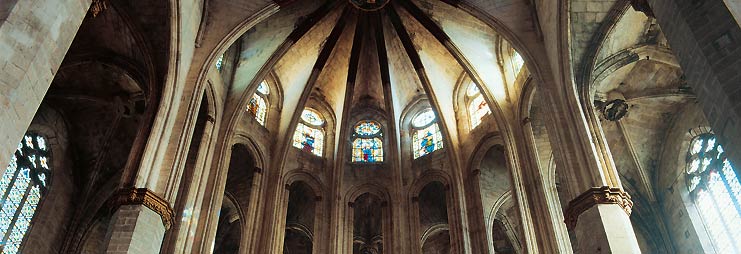
In contrast with the exterior, the interior gives an impression of light and spaciousness. It is of the basilica type, with its three aisles forming a single space with no transepts and no architectural boundary between nave and presbytery. The simple ribbed vault is supported on slender octagonal columns set 13 metres apart center to center, a distance unsurpassed by any other existing medieval building, and abundant daylight streams in through the tall clerestorey windows.
This gives the impression of sublime width, height and airiness, as if gravity had been reversed and pulled the immense blocks of stone upwards. The many stained-glass windows of the church of Santa Maria del Mar play an important role in giving this impression. Especially the west end with its rose window, showing the proportions of the three aisles
The interior is almost devoid of imagery of the sort to be found in Barcelona's other large Gothic churches, the cathedral and Santa Maria del Pi, after the fire which occurred in 1936 during anticlerical disturbances. Amongst the most notable of the works destroyed at that time was the Baroque retable by Deodat Casanoves and Salvador Gurri. Some interesting stained-glass windows have survived from various periods.
Back : Old City East Tour
Sources : barcelona.de architecture.relig wikipedia
Inscription à :
Articles (Atom)